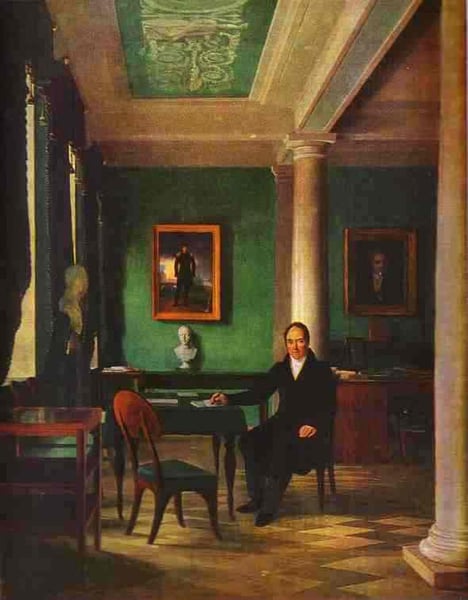
Portrait of the State Chancellor of the Internal Affairs, Prince Victor Pavlovich Kochubey in his Study
Details
Expertenanalyse zu Alexey Venetsianovs Portrait of the State Chancellor of the Internal Affairs, Prince Victor Pavlovich Kochubey in his Study
Stil: Realism · Genre: portrait
Expert Analysis: Portrait of the State Chancellor of the Internal Affairs, Prince Victor Pavlovich Kochubey in his Study by Alexey Venetsianov
This portrait is a masterful example of Russian Realism from the early 19th century, a period when the style was emerging as a force for truthful, unidealized representation. While Alexey Venetsianov is celebrated for his pioneering depictions of peasant life, this work demonstrates his equal command of state portraiture—but with a distinctly Realist approach that personalizes rather than merely glorifies his subject.
Significance within Realism:
Venetsianov rejects the bombastic, allegorical trappings of Neoclassical or Romantic state portraits. Instead, he places Prince Kochubey in his private study, surrounded by the tangible tools of governance: papers, books, and a desk. The setting is intimate yet authoritative, grounding the Chancellor’s power in everyday bureaucratic labor rather than in symbolic grandeur. This aligns with Realism’s commitment to depicting the subject’s actual environment and social role without flattery or mythologizing.
Psychological Depth:
The Prince is shown not in an idealized pose but in a moment of quiet reflection, his gaze thoughtful and slightly weary. Venetsianov captures the weight of administrative responsibility—Kochubey was a key minister under Alexander I—through subtle details: the furrowed brow, the open document, the careful lighting on his face. The Realist lens reveals the man behind the title, emphasizing interiority over status.
Artistic Technique:
Venetsianov uses a restrained palette and soft, naturalistic lighting to model the Chancellor’s features with precision. The background is composed of muted browns and greens, focusing attention on the face and hands. Unlike the slick finish of academic portraiture, Venetsianov’s brushwork retains a tactile quality, suggesting the lived-in reality of the study.
Historical Context:
At a time when Russian portraiture often served as propaganda for the imperial court, Venetsianov’s choice to depict a high-ranking official with such unvarnished honesty was a radical gesture. It elevates realism as a tool for psychological insight, bridging the gap between official duty and personal character. This work stands as a key example of how Russian Realism, while focusing on commoners, could also transform the state portrait into a document of human truth.
Visuell ähnlich
20 Werke mit ähnlicher Komposition und Farbpalette
Peter the Great Interrogating the Tsarevich Alexei Petrovich at Peterhof
Nikolai Ge
Sir Lawrence Dundas and his Grandson Lawrence
Johan Zoffany
Self Portrait in his Study
Carl Moll
Portrait de Louis-Antoine Garnier-Pagès (1803-1878)
Aimee Brune-Pages
Hugh Reynolds Rathbone (1862–1940), at Greenbank House
Leonard Campbell Taylor
The First Council of Queen Victoria
David Wilkie
Literary reading
Vladimir Makovsky
Pushkin in the village Mihaylovskoye
Nikolai Ge
John Forster (1812–1876), in His Library
Edward Matthew Ward
Proclaiming the Union
Theodor Aman
In the living room in Moscow in 1840's
Boris Kustodiev
Study of a Seated Man in an Interior, Holding a Book
Henry Stacy-Marks
The Brown Family
Eastman Johnson
Gentleman in his library
Eduard Ender
Balmaceda Ministros
Pedro Subercaseaux
Portrait of Ferdinando Nerli (1770-1829) seated in an interior, full-length
Louis Gauffier
The John Bacon Family
Arthur Devis
Doctorul Grunau
Constantin Daniel Rosenthal
James Palmer, Treasurer of Christ's Hospital
Thomas Lawrence
Portrait of Charles Maurice de Talleyrand-Perigord
Pierre-Paul Prud'hon