
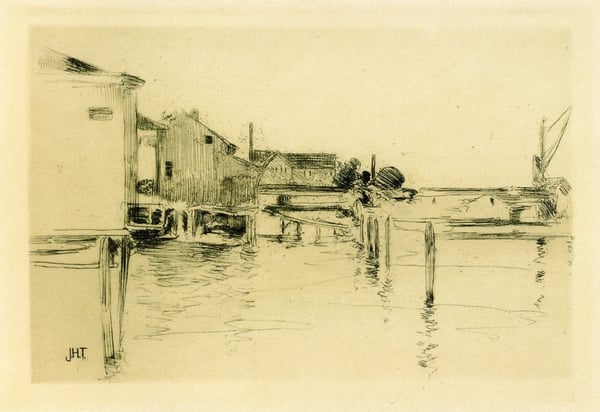
Expert analysis of John Henry Twachtman’s Bridgeport
Style: Impressionism · Genre: landscape
As an expert in art history, I will provide an analysis of John Henry Twachtman's Bridgeport based solely on the structured facts provided: it is an Impressionist landscape.
Analysis
John Henry Twachtman's Bridgeport stands as a significant contribution to American Impressionism, a movement that adapted the French style to the unique light and atmosphere of the New World. As a landscape, the work exemplifies the genre's shift away from precise topographical representation toward a subjective, sensory experience of a scene.
What makes this artwork significant within its style/period:
-
Pure Engagement with Impressionist Principles: The work fully embraces the core Impressionist tenet of capturing a fleeting moment of light and atmosphere. As a landscape, Bridgeport is not merely a picture of a place, but a record of the artist’s perception of the environment at a specific time. The title grounds it in a real location (Bridgeport, Connecticut), but Twachtman's focus is on translating the optical effects—the shimmer of light on water, the softness of the air—into paint.
-
Twachtman’s Personal, Subtle Palette: While the facts do not describe the colors, the artist is renowned for using a subdued, tonal palette that is distinct within the broader Impressionist movement. In a period when many Impressionists favored bright, high-contrast colors, Twachtman often worked in a muted harmony of whites, grays, greens, and blues. For Bridgeport, this suggests a sophisticated refinement, where significance lies not in dramatic color effects but in the subtle modulation of tone to convey mood and atmosphere.
-
A Bridge to the Modern Landscape: Twachtman’s landscapes, including Bridgeport, are significant for their introspective quality. They move beyond simple documentation to become quiet meditations on nature. The work’s importance in its period stems from how it synthesizes the technical innovations of French Impressionism (broken brushwork, attention to reflected light) with a distinctly American sensibility of reverence for nature and an almost poetic sense of quietude. This combination helped define a sophisticated, lyrical branch of American landscape painting at the turn of the 20th century.
In summary, Bridgeport is a significant artwork within the Impressionist style and its period because it represents a mature and refined iteration of Impressionist landscape theory. It demonstrates how the movement could be adapted to create quiet, atmospheric studies that prioritize personal perception and harmonious mood over narrative or dramatic spectacle, marking a high point in Twachtman’s career and in American Impressionist painting itself.
Museum / Gallery
Visually similar
20 works with related composition and palette
Harbor View
John Henry Twachtman
The Shore
John Henry Twachtman
View over the Amstel from the Rampart
Rembrandt
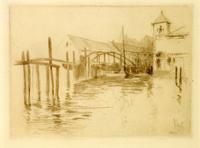
Dock at Newport
John Henry Twachtman
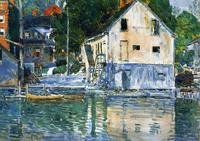
Casa Eby, Cos Cob
Childe Hassam
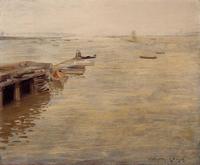
Seashore (aka A Grey Day)
William Merritt Chase
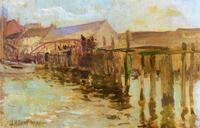
The Landing, Newport
John Henry Twachtman
Cape Town Harbour
Gregoire Boonzaier
Brookville
T. C. Steele
Canal Scene near Accrington
L. S. Lowry
Waterfront Scene Gloucester
John Henry Twachtman
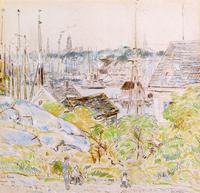
The Harbor of a Thousand Masts, Gloucester
Childe Hassam
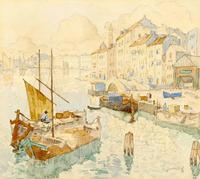
Riva Dei Sette Martiri, Venice
Konstantin Gorbatov
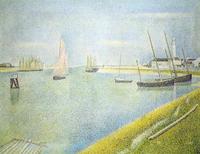
The Channel at Gravelines, in the Direction of the Sea
Georges Seurat
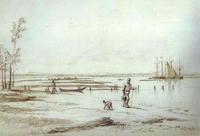
In the Suburbs of St. Petersburg
Alexander Orlowski
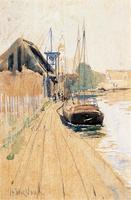
Waterside Scene
John Henry Twachtman
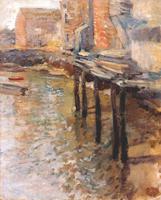
The Old Mill at Cos Cobb
John Henry Twachtman

The harbour of Venice, the island of San Georgio
Ivan Aivazovsky
The old ship, Williamstown
Frederick McCubbin
Beira-mar
Mario Zanini