
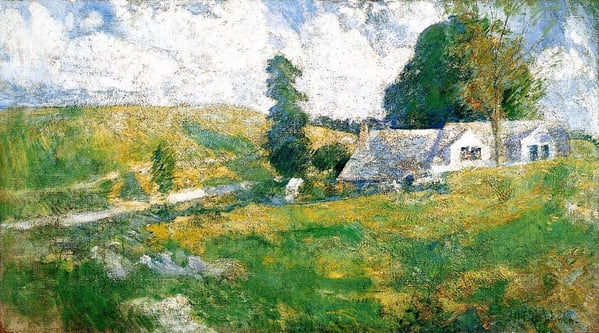
Expert analysis of John Henry Twachtman’s Summer
Style: Impressionism · Genre: landscape
As an art historian, here is an expert analysis of Summer by John Henry Twachtman, based solely on the provided facts.
Artwork: Summer
Artist: John Henry Twachtman
Style: Impressionism
Genre: Landscape
Analysis & Significance:
John Henry Twachtman's Summer is a masterful example of American Impressionism, distinguished not by the vibrant, sun-drenched palette of its French counterpart, but by its quiet, tonal subtlety. While the artwork is categorized broadly under Impressionism—capturing a fleeting moment of light and atmosphere—Twachtman's unique contribution lies in his ability to distill the landscape into a hushed, almost poetic harmony.
The significance of Summer within Twachtman's oeuvre and the Impressionist movement is threefold:
-
A Personal, Introspective Vision: Unlike the more social or urban scenes favored by French Impressionists (e.g., Renoir or Monet), Twachtman—even in a work titled Summer—often turned inward. He transformed a generic landscape into an intimate, contemplative space. The work likely emphasizes a meditative stillness over pure visual spectacle, a hallmark of his mature style.
-
Mastery of Tone over Chromatic Brilliance: Twachtman is renowned for his delicate, restricted palette—often favoring silvery greens, soft grays, and muted whites. In Summer, he would not be seeking the blazing heat of midday but rather a softer, more humid luminosity. This tonal approach was a deliberate deviation from the high-keyed color of European Impressionism, allowing him to evoke the feeling of a season rather than its mere visual fact.
-
Integration of Japanese Aesthetics: Twachtman, like many of his contemporaries, was influenced by Japanese woodblock prints. In Summer, one can expect an asymmetrical composition, a flattened picture plane, and a strong sense of decorative pattern—especially in the treatment of foliage and water. This gives the work a profound sense of design and balance that elevates it beyond a simple plein-air sketch.
In conclusion, Summer is significant because it represents the American Impressionist's quest to marry the optical truths of the French style with a deeply personal, lyrical, and structurally refined approach to the landscape. It is a work that whispers its beauty rather than shouts it, marking Twachtman as one of the most sensitive and original poets of the American countryside.
Visually similar
20 works with related composition and palette
Summer Late
John Henry Twachtman
Artist's Home in Autumn, Greenwich, Connecticut
John Henry Twachtman
Twachtman's House
John Henry Twachtman
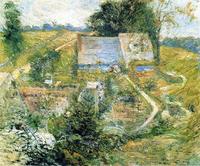
From the Upper Terrace
John Henry Twachtman
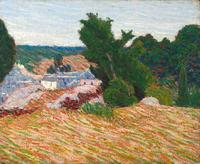
The Farm
Roderic O'Conor
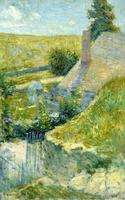
Artist's Home Seen from the Back
John Henry Twachtman
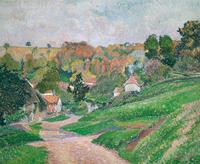
Milton, East Knoyle
Lucien Pissarro
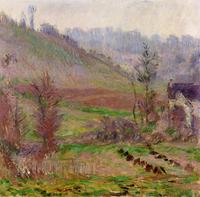
Valley of Falaise
Claude Monet
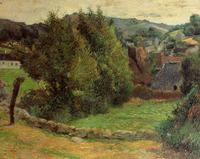
Landscape at Pont-Aven
Paul Gauguin
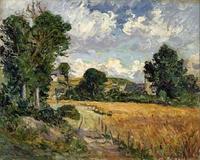
Cornfield in the Valley of Saint-Jean-du-Doigt
Maxime Maufra
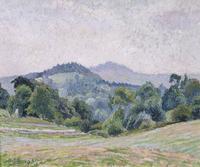
The Hills from Hayfield Green
Lucien Pissarro
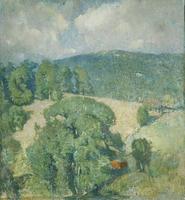
Connecticut Hillside
Emil Carlsen
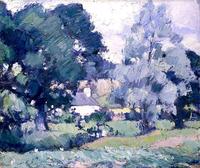
Summer New Abbey
Samuel Peploe
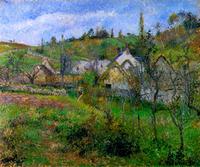
Le Valhermeil, near Pontoise
Camille Pissarro
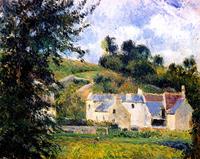
Houses of l'Hermitage, Pontoise
Camille Pissarro
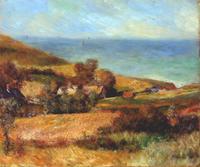
View of the normandy coast near wargemont
Pierre-Auguste Renoir
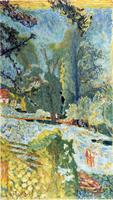
Landscape in Normady
Pierre Bonnard
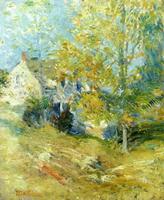
The Artist's House through the Trees (also known as Autumn Afternoon)
John Henry Twachtman
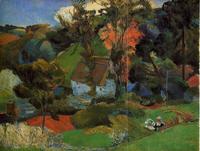
Aven running through Pont-Aven
Paul Gauguin
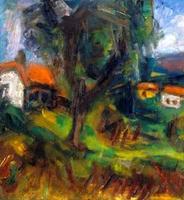
Czóbel Béla , Szentendre Törökvölgy
Bela Czobel