Expert analysis of Norman Rockwell’s Southern Justice (Murder in Mississippi)
Style: Regionalism, Social Realism · Genre: genre painting
Expert Analysis: "Southern Justice (Murder in Mississippi)" by Norman Rockwell
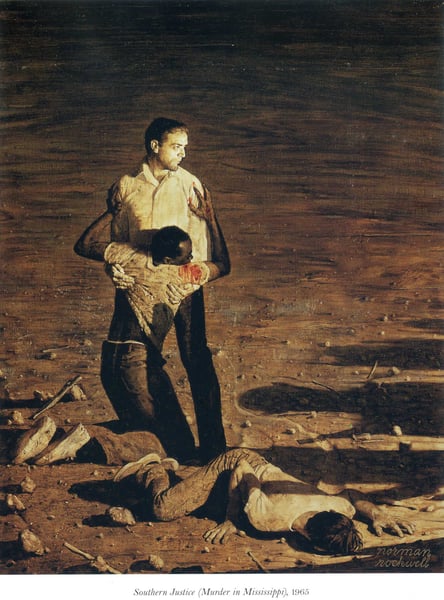
Norman Rockwell’s Southern Justice (Murder in Mississippi) stands as a searing departure from his beloved, idyllic depictions of American life, marking a pivotal moment where he fused the accessible narrative of Regionalism with the urgent social critique of Social Realism. Created in response to the 1964 murders of civil rights workers James Chaney, Andrew Goodman, and Michael Schwerner, this genre painting transforms Rockwell’s characteristic illustrative clarity into a weapon against racial violence.
Significance within Style and Period
-
Regionalism’s Familiarity Turned Critique: Regionalism typically celebrated rural American scenes with warmth and nostalgia. Rockwell subverts this by placing a brutally contemporary, violent act within a recognizably American setting—a dark roadside under a pale moon. The composition’s grounded, almost documentary quality (the prone body, the shadowy figures of the Klansmen) forces the viewer to confront a hidden truth of the American South, using the style’s directness to indict rather than comfort.
-
Social Realism’s Moral Urgency: Unlike Rockwell’s earlier, apolitical work, this piece aligns with Social Realism’s mission to expose injustice. The anguished, isolated figure of the murdered man (modeled after the victims) becomes a universal symbol of martyrdom. Rockwell’s meticulous attention to expression—the victim’s stillness versus the aggressors’ silhouetted menace—amplifies the emotional weight, turning a news story into a timeless indictment of hate.
-
A Turning Point in Rockwell’s Career: Known for The Four Freedoms and Saturday Evening Post covers, Rockwell risked his mainstream popularity to address civil rights. Southern Justice was rejected by the Post and later published in Look magazine, signaling his shift toward activist art. Its significance lies in how it weaponized the very techniques of sentimental American illustration—warm colors, relatable figures, narrative clarity—to deliver an uncompromising condemnation of Southern racism.
In this work, Rockwell proves that the most potent art can emerge from a gentle hand turned hard. It remains a landmark of American social commentary, bridging the gap between popular illustration and protest art.
Visually similar
20 works with related composition and palette
The Thieves and the Donkey
Honore Daumier
Untitled
Ben Shahn
Funeral of fallen
August von Pettenkofen
Untitled
Zdzislaw Beksinski
War scene
Francisco Goya
The Battlefield
Kathe Kollwitz
The Murder
Paul Cezanne
Cardinal, Cardinal
Salvador Dali
The Fifth Plague. Livestock Disease
Gustave Dore
Black Spot
N.C. Wyeth
Spain
Salvador Dali
Il bambino
Mario Comensoli
Fighting Bricklayer
Honore Daumier
Etude lying to the boy's painting 'The Court Pugachev'
Vasily Perov
Amants de Village
Theophile Steinlen
The Doctor
C. R. W. Nevinson
Disparate furioso
Francisco Goya
Bodies in a grave, Belsen
Alex Colville
Robbe-Grillet Cleansing Every Object in Sight
Mark Tansey
Excavation of the buried people
Carlo Ademollo