
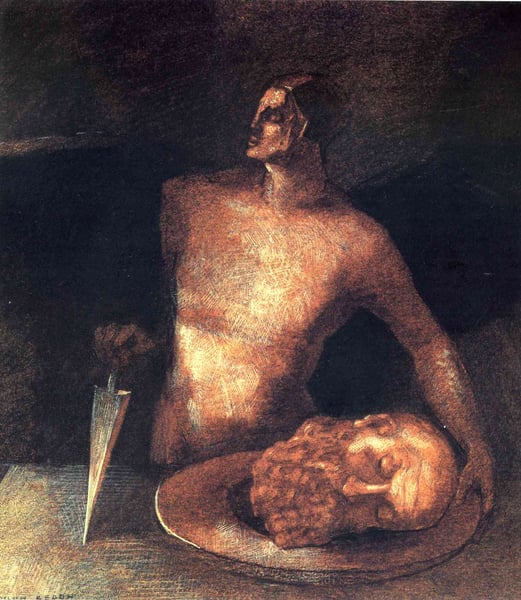
Analisi esperta di Angel Executions di Odilon Redon
Stile: Symbolism · Genere: religious painting
Expert Analysis of "Angel Executions" by Odilon Redon
Odilon Redon’s Angel Executions stands as a quintessential example of Symbolist religious painting, a genre he radically reimagined by subverting traditional devotional iconography. Within the Symbolist movement—which prized subjective emotion, dream imagery, and the evocation of the unseen over literal representation—Redon’s work achieves significance precisely through its unsettling fusion of the sacred and the macabre.
The title itself is oxymoronic: angels, typically agents of divine mercy or messengers of hope, are here linked with execution, an act of finality and violence. This paradox is central to the painting’s power. Redon does not depict a conventional biblical scene; instead, he conjures a psychological or spiritual landscape where celestial beings become instruments of an ambiguous, perhaps inexorable, fate. The figures likely appear as amorphous, shadowy presences, rendered in Redon’s characteristic “noirs”—the deep, velvety blacks of his charcoal and lithographic works from the 1870s–1890s—or, in later versions, in haunting pastels. This tonal ambiguity denies the viewer a clear narrative, forcing an introspective response.
What makes Angel Executions significant within Symbolism is its rejection of the didactic clarity of earlier religious painting. While a Renaissance or Baroque artist would depict martyrdom with explicit drama and moral certainty, Redon presents a scene that is deliberately indeterminate: Are the angels executing a judgment? Or are they themselves condemned? The emotional register hovers between awe, dread, and melancholy. This aligns with the Symbolist credo that art should “clothe the idea in sensible form” (Jean Moréas) while leaving meaning open to the beholder’s subconscious.
Redon’s technical choices further amplify this effect. His use of soft, dissolving contours and stark contrasts of light and shadow creates a sense of apparition—forms that seem to emerge from and recede into darkness. The composition likely denies a stable ground, floating figures in a void-like space that suggests the interior of a dream or a liminal spiritual realm. By doing so, Redon transforms religious painting from a vehicle of doctrine into a vessel for existential uncertainty, a hallmark of his most important Symbolist works.
In the broader context of Redon’s oeuvre, Angel Executions bridges his early monochromatic “noirs” (inspired by Goya and the fantastical) and his later, more colorful works like The Cyclops. It exemplifies how Symbolism, through artists like Redon, renewed religious art not by reinforcing faith but by plumbing the depths of doubt, mystery, and the irrational—making the invisible world palpably, and disturbingly, present.
Visivamente simili
20 opere con composizione e palette affini
Self-portrait
Marià Fortuny
Death of Viala
Pierre-Paul Prud'hon
Untitled (Women Series)
Nalini Malani
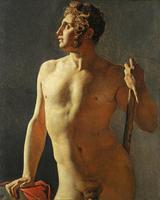
Male Torso
Jean Auguste Dominique Ingres
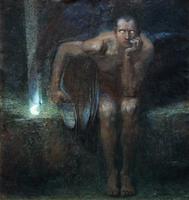
Lucifer
Franz Stuck
Fishmonger
Mario Sironi
Lenin
Alexander Roitburd
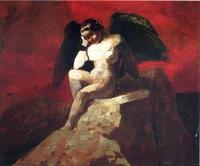
Angel in Chains
Odilon Redon
De Profundis
Yervand Kochar
Hepatitis
Odd Nerdrum
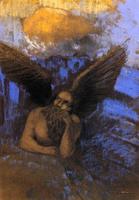
Aged Angel
Odilon Redon
Satyr Peter
Peter Paul Rubens
The Miser
Thomas Couture
Hermit
Anton Azbe

A Personification Of Geometry
Dosso Dossi
Judith and Holofernes
Franz Stuck
Thinking naked boy
Marià Fortuny
Study for Androcles
Henry Ossawa Tanner
Study of a Head
Eduard von Gebhardt
St. Jerome Penitent
El Greco