
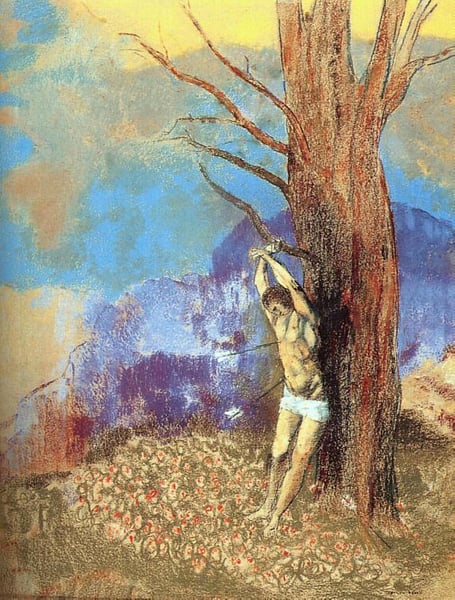
Analisi esperta di Saint Sebastian di Odilon Redon
Stile: Symbolism · Genere: religious painting
Expert Analysis: "Saint Sebastian" by Odilon Redon
Odilon Redon’s Saint Sebastian stands as a quintessential example of Symbolist religious painting, diverging sharply from the naturalistic and devotional traditions of earlier centuries. Created during a period when Redon had moved from his famous monochromatic “noirs” into a vibrant, pastel-driven palette, this work reimagines the martyrdom of the early Christian saint through a lens of psychological introspection and spiritual ambiguity—hallmarks of the Symbolist movement.
Significance within Symbolism
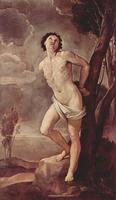
In traditional Renaissance or Baroque depictions—such as those by Mantegna or Guido Reni—Saint Sebastian is shown with precise anatomical clarity, pierced by arrows, his face often upturned in ecstatic suffering. Redon subverts this narrative. Rather than focusing on physical agony, he dissolves the body into an almost specter-like presence. The saint appears as a floating, isolated figure, suspended in a rich, indeterminate space of deep blues, violets, and gold. The arrows, if present, are rendered more as abstract symbols of divine wounding than as literal projectiles. This effacement of concrete detail is central to Symbolism: Redon prioritizes emotional resonance and the evocation of the ineffable over narrative or anatomical realism.
Color, Atmosphere, and Mysticism
Redon’s use of color is transformative. The glowing, almost otherworldly halo that surrounds Sebastian’s head is not a simple gold disk but a soft, irradiated haze that blurs the boundary between figure and background. This technique creates a dreamlike state where the martyr seems to exist both in this world and beyond it—a visual metaphor for the soul’s transcendence. The cool, nocturnal tones suggest a state of reverie or trance, aligning with Symbolist interests in the subconscious, the mystical, and the symbolic power of suggestion.
Break from Tradition
What makes this work particularly significant is how Redon preserves the religious subject while stripping it of didactic or theatrical suffering. There is no blood, no stark drama; instead, the image invites contemplation. The saint becomes a vessel for meditative silence. This approach reflects the broader Symbolist rejection of materialism and positivism, embracing instead the idea that art should express the unseen, the spiritual, and the personal vision of the artist.
In Saint Sebastian, Odilon Redon achieves a rare fusion: a religious icon that is also a modern, subjective symbol of inner pain and luminous peace. It remains a pivotal work for understanding how Symbolism transformed sacred art into a vehicle for private, metaphysical experience.
Museum / Gallery
Visivamente simili
20 opere con composizione e palette affini
Saint Sebastian
Odilon Redon
The Martyrdom of Saint Sebastian
Odilon Redon

Albert, Companion of Saint William
Salvator Rosa

The Fugitive
John Steuart Curry
Christ on the Cross
Odilon Redon
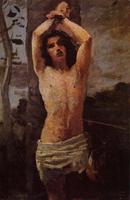
Saint Sebastian
Camille Corot
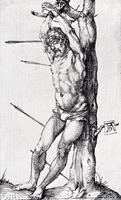
St. Sebastian At The Tree
Albrecht Durer
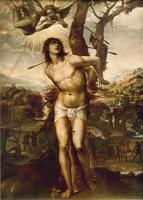
St Sebastian
Il Sodoma
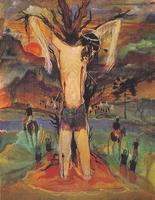
São Sebastião
Alberto da Veiga Guignard

St. Sebastian
Taras Shevchenko

St. Sebastian
El Greco
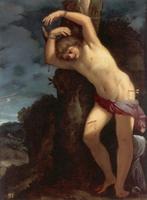
Saint Sebastian
Ludovico Carracci
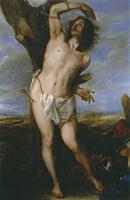
San Sebastián
Juan Carreno de Miranda
The evil thief
Albrecht Durer
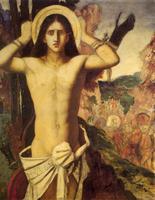
Saint Sebastian
Gustave Moreau
St Sebastian
Palma il Giovane
St. Jerome Penitent
Antonello da Messina
Christ on the Cross
Eugene Delacroix
Bereny Robert, Krisztus a Kereszten. 1912
Berény Róbert
St. Sebastian
Guido Reni