Expert analysis of Juan Carreno de Miranda’s San Sebastián
Style: Baroque · Genre: religious painting
Expert Analysis of San Sebastián by Juan Carreño de Miranda
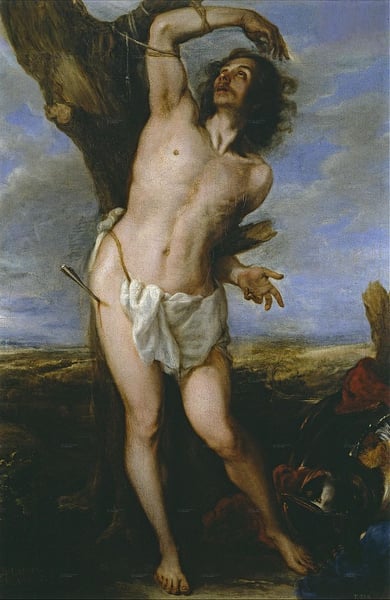
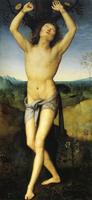
As a work of the Baroque style and a religious painting within its genre, Carreño de Miranda’s San Sebastián achieves significance through its masterful embodiment of Baroque principles while adhering to the devotional demands of Counter-Reformation art.
Stylistic Significance within the Baroque:
- The Baroque period prized emotional immediacy and dramatic naturalism. Carreño’s depiction of Saint Sebastian—a Christian martyr pierced by arrows—would have harnessed these qualities to create a vivid, almost tangible sense of suffering and transcendence. The painting likely employs strong chiaroscuro (contrast of light and shadow) to heighten the physical and spiritual drama, focusing the viewer’s eye on the saint’s agonized but serene expression. This technique aligns with Baroque aims to involve the spectator in a direct, empathetic encounter with the sacred narrative.
Genre Significance:
- As a religious painting, San Sebastián serves a didactic and inspirational function typical of the period: it both glorifies the saint’s faith and reinforces the Catholic Church’s emphasis on martyrdom as a path to salvation. Carreño’s treatment likely balances idealized beauty with stark realism—a hallmark of Spanish Baroque—making the saint’s heroic endurance relatable yet awe-inspiring.
Artistic Context:
- Carreño de Miranda, active in the Spanish court of Charles II, was a leading figure in Madrid’s Baroque school. His San Sebastián stands as a refined example of how Spanish Baroque religious painting fused Italianate drama with a native penchant for sober, tangible humanity. The work’s significance lies in its ability to generate profound spiritual resonance through controlled composition, emotive facial expression, and a careful handling of the saint’s wounded body—transforming physical pain into a testament of unwavering faith.
In sum, this painting is significant as a compelling synthesis of Baroque theatricality and religious sincerity, showcasing Carreño’s skill in creating an image that is both historically instructive and emotionally compelling within its period and style.
Visually similar
20 works with related composition and palette
St Sebastian
Palma il Giovane
Saint Sebastian
Ludovico Carracci
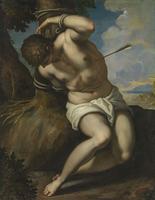
Saint Sebastian
Palma il Giovane
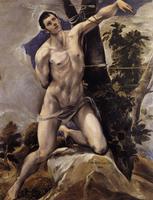
St. Sebastian
El Greco
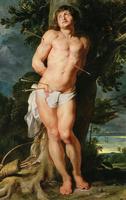
St. Sebastian
Peter Paul Rubens
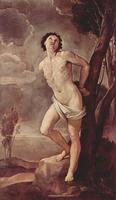
St. Sebastian
Guido Reni
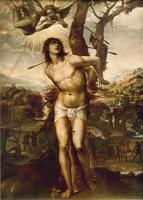
St Sebastian
Il Sodoma
St Sebastian
Titian
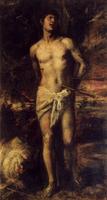
St Sebastian
Titian
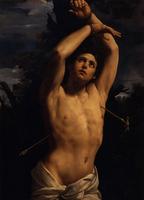
The Martyrdom of Saint Sebastian
Guido Reni
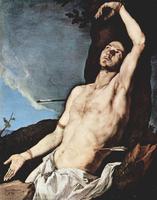
St. Sebastian
Jusepe de Ribera
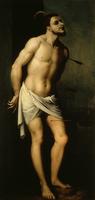
San Sebastián
Francesco Ribalta
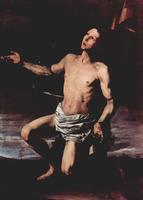
St. Sebastian
Jusepe de Ribera

Saint Sebastian
John Graham-Gilbert
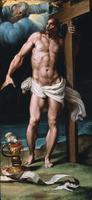
Blood of the Redeemer
Bartolomeo Passerotti
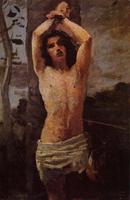
Saint Sebastian
Camille Corot
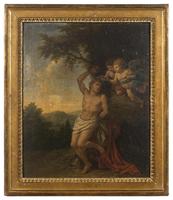
Deux anges apportant une couronne à saint Sébastien
Louis Jean Francois Lagrenee
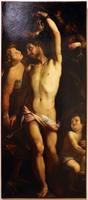
San Sebastiano
Giulio Cesare Procaccini
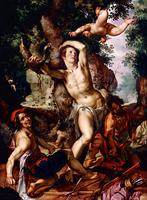
Martyrdom of St. Sebastian
Joachim Wtewael
St. Sebastian
Pietro Perugino