Analyse experte de The Port of Morgat de Odilon Redon
Style : Impressionism · Genre : landscape
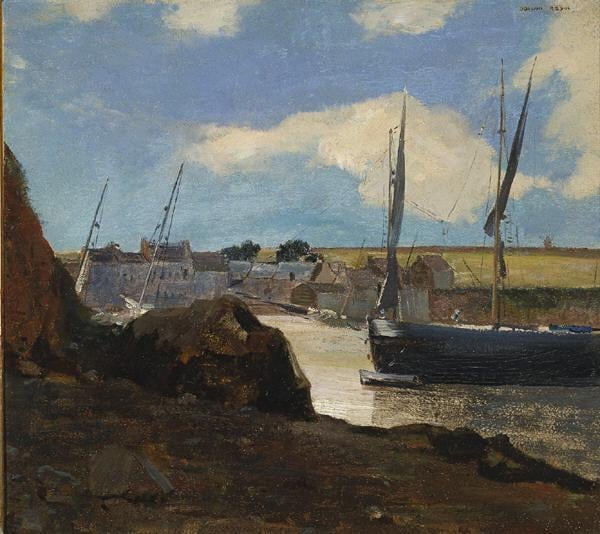
Expert Analysis of "The Port of Morgat" by Odilon Redon
Odilon Redon is celebrated as a master of Symbolism—a realm of dreams, fantasies, and the subconscious. Yet in The Port of Morgat, he steps firmly into the arena of Impressionism, a style defined by its pursuit of light, atmosphere, and the fleeting moment. This work’s significance lies precisely in this apparent contradiction: a visionary artist grounding his vision in the tangible, coastal landscape of Brittany.
Executed as an Impressionist landscape, the painting captures the harbor of Morgat with a palette of soft blues, silvery grays, and muted earth tones. Redon employs the hallmark Impressionist techniques of broken brushwork and an emphasis on natural light, observing how sunlight shimmers on water and diffuses through the maritime air. Boats rest at anchor, the quayside structures are rendered with loose, suggestive strokes, and the sky is a breathing expanse of subtle tonal shifts. The composition feels spontaneous, as if caught in a single, luminous instant.
What makes The Port of Morgat particularly significant within Redon’s oeuvre—and within the broader Impressionist movement—is its rare testimony to the artist’s dialogue with contemporary plein-air practice. While Redon’s more famous works (the charcoal noirs, the mystical pastels) dwell in inner worlds, this painting demonstrates his acute sensitivity to the outer, physical world. It reveals that the same sensibility which conjured phantom flowers and floating eyeballs could also observe a harbor with serene, empirical clarity. The work thus serves as a crucial counterpoint: it expands the definition of Impressionism by showing it through the eyes of an artist whose main legacy lies elsewhere, and it enriches our understanding of Redon as a versatile painter who briefly—yet masterfully—embraced the movement’s core ethos of capturing the evanescent beauty of the natural world.
Museum / Gallery
Visuellement similaire
20 œuvres à la composition et à la palette proches
Two Masted Schooner, Concarneau
Robert Henri
Camaret, Low Tide
Eugene Boudin
The Ferry to Deauville
Eugene Boudin
Isle of Brehat
Maxime Maufra
Trouville, the Port
Eugene Boudin
Trouville, the Inner Port, Low tide
Eugene Boudin
The Port of Dieppe
Charles-Francois Daubigny
The Village and the Port on the River
Eugene Boudin
Boats Lying at Low Tide at Facamp
Claude Monet
Camaret
Eugene Boudin
Rosbras, Brittany
Berthe Morisot
Harbor in the Port of Fecamp
Berthe Morisot
The Seine Estuary at Honfluer
Claude Monet
Fish Sheds and Schooner, Gloucester
John Henry Twachtman
Harbour Scene with Fishing Boats
James Campbell Noble
The Port of Trouville
Eugene Boudin
Seehafen
Eugene Boudin
Laundresses on the Banks of the Port of Trouville
Eugene Boudin
The Jetties, Low Tide, Trouville
Eugene Boudin
The Port at Saint-Vaast-la-Houghe
Eugene Boudin