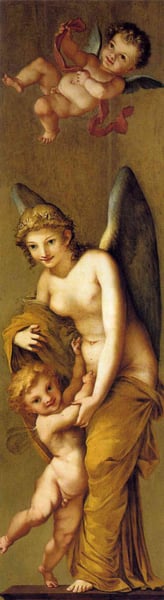
Arts, Wealth, Pleasure and Philosophy: Pleasure
Dettagli
Analisi esperta di Arts, Wealth, Pleasure and Philosophy: Pleasure di Pierre-Paul Prud'hon
Stile: Neoclassicism · Genere: allegorical painting
Expert Art Historical Analysis:
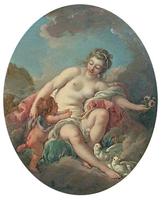
Pierre-Paul Prud'hon's "Arts, Wealth, Pleasure and Philosophy: Pleasure" stands as a distinctive contribution to Neoclassical allegory, revealing the movement's capacity for sensuousness and psychological depth beyond its more austere, didactic conventions. Executed during a period when Neoclassicism was increasingly challenged by emerging Romantic sensibilities, Prud'hon’s interpretation of "Pleasure" within this allegorical series is significant for its fusion of rigorous classical form with a soft, atmospheric handling that anticipates later 19th-century tendencies.
As an allegorical painting, the work participates in the Enlightenment tradition of personifying abstract concepts, yet Prud'hon infuses the figure of Pleasure with a palpable, almost melancholic delicacy. The title’s placement within a tetrad—alongside Arts, Wealth, and Philosophy—suggests a philosophical meditation on the balanced life, a core Neoclassical theme derived from ancient ethics. Where many Neoclassical artists, following Jacques-Louis David, emphasized sharp contours, clear narrative, and stoic moral clarity, Prud'hon employs a sfumato-like softness and a subtle chiaroscuro that gives the figure an ethereal, dreamlike quality. This technique, borrowed from Correggio and Leonardo, endows "Pleasure" with a transient, fleeting character—elevating the allegory beyond simple didacticism into a nuanced reflection on the ephemeral nature of joy.
The work’s significance lies precisely in this tension: it is Neoclassical in its idealized form, balanced composition, and allegorical purpose, yet it is proto-Romantic in its emphasis on emotion, atmosphere, and the ineffable. Prud'hon’s "Pleasure" thus occupies a pivotal position, demonstrating that Neoclassicism was not monolithic but capable of incorporating sensuality and introspection. This piece enriches our understanding of the period by showing how allegory could be both intellectually rigorous and emotionally resonant, bridging the rational clarity of the 18th century with the subjective intensity of the Romantic era.
Visivamente simili
20 opere con composizione e palette affini
Venus and Cupid
James Thornhill

Mrs. Crewe
Joshua Reynolds
Urania and Erato
Sebastiano Conca
The Holy Family. The Rest on the Flight into Egypt
Giulio Cesare Procaccini
Holy Family with John the Baptist and An Angel
Giulio Cesare Procaccini
Virgin, Child and St John
Haerman Verelst
Venus and Cupid
Correggio
Angels
Konstantin Makovsky
Allegory of Wealth
Simon Vouet
Maria Mit Kind, Dem Johannesknaben Und Einem Engel
Giulio Cesare Procaccini
Marriage of Cupid and Psyche
Pompeo Batoni
Mary, John and baby Jesus
Rudolf Ernst
Venus with Mercury and Cupid (The School of Love)
Correggio
The Mystic Marriage of St Catherine
Giulio Cesare Procaccini
The Guardian Angel
Pietro da Cortona
VENUS AND CUPID
Ventura Salimbeni
1. The Destiny of Marie De' Medici
Peter Paul Rubens
The Fate Spinning Maries Destiny
Peter Paul Rubens
Madonna and Child with the Young St. John
Andrea del Sarto
Venus Restraining Cupid
Francois Boucher