Expert Analysis: "Young Naiad Tickled by the Cupids" by Pierre-Paul Prud'hon
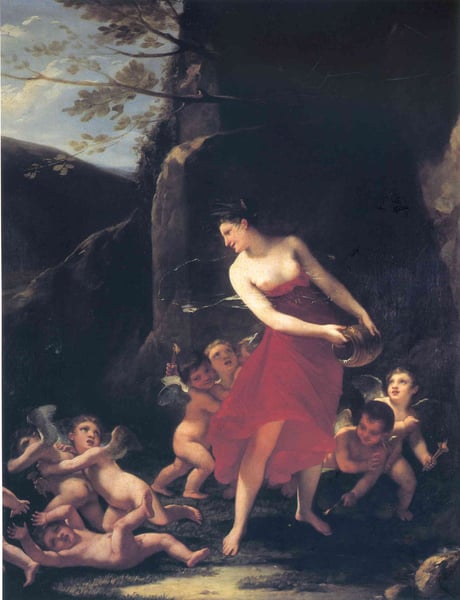
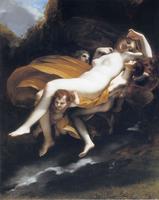
As a mythological painting executed within the Romantic style, this work is significant for its embodiment of key Romantic ideals—emotion, sensuality, and the sublime—mediated through classical mythology. Prud’hon moves beyond the rigid formalism of Neoclassicism, infusing the mythological genre with a tender, almost theatrical playfulness. The subject—a young naiad (a water nymph) being tickled by cupids—allows the artist to explore the intersection of innocence and eroticism, a hallmark of Romanticism’s fascination with psychological states and the senses.
The composition likely capitalizes on soft chiaroscuro and fluid, melting contours (a Prud’hon trademark) to create a dreamlike, ethereal atmosphere. This approach distinguishes the painting within Romanticism, as it prioritizes mood and emotional vulnerability over didactic narrative or heroic action. The naiad’s responsive, laughing pose and the cupids’ mischievous engagement transform a traditional mythological trope into a study of human delight and vulnerability. In doing so, the work exemplifies Romanticism’s turn toward the intimate and the fleeting, while still paying homage to classical motifs—a synthesis that underscores Prud’hon’s unique position as a bridge between Neoclassical structure and Romantic sensibility.