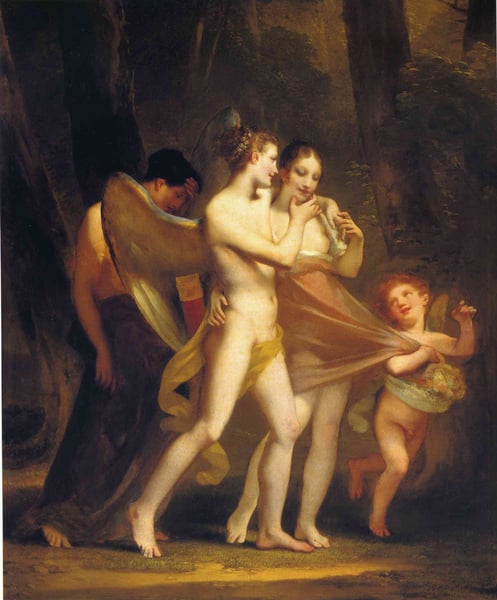
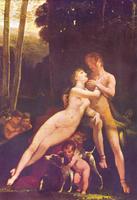
Pierre-Paul Prud'hon's "Love Seduces Innocence, Pleasure Entraps, and Remorse Follows" stands as a quintessential Romantic allegory, where raw emotion and moral tension are rendered through a sequence of psychological states rather than a single static scene. The work’s significance lies in how it embodies the Romantic fascination with the inner drama of human experience—specifically the inevitable fall from grace—using allegory not as a cold lesson but as a visceral, almost theatrical narrative. Prud'hon merges the idealized forms of Neoclassicism with the soft, sfumato-like chiaroscuro and turbulent emotional intensity that would define early Romanticism. The progression from seduction to entrapment to remorse creates a temporal arc within a single canvas, inviting the viewer to feel the weight of each stage. This painting is notable for its ability to transform a moralizing tale into a deeply personal, sensual, and haunting meditation on desire and consequence, marking a shift from didactic allegory to psychological exploration.