Analisi esperta di Adoration of the Magi di Domenico Ghirlandaio
Stile: Early Renaissance · Genere: religious painting
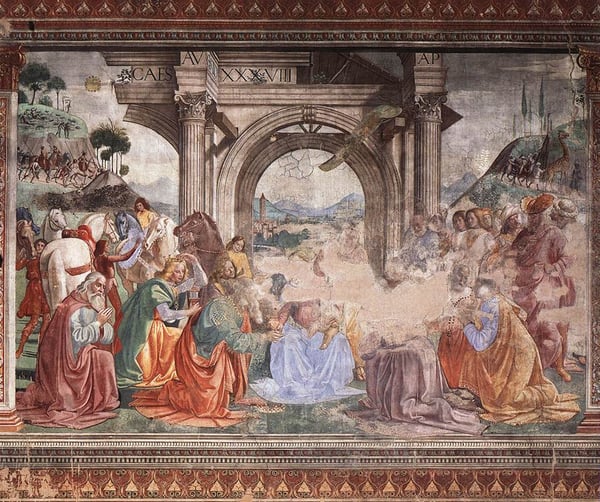
Domenico Ghirlandaio’s Adoration of the Magi exemplifies the transition from late Gothic detail to the naturalism and spatial coherence of the Early Renaissance. Painted in the 1480s, the work is celebrated for its masterful integration of sacred narrative with contemporary Florentine life—a hallmark of Ghirlandaio’s style and a key feature of the period’s religious painting.
Significance within the Early Renaissance:
-
Narrative clarity and compositional balance: Ghirlandaio arranges the Magi and their retinue in a sweeping diagonal from left to right, leading the eye directly to the Christ Child and the Virgin. This careful use of perspective and spatial recession creates a believable, stage-like setting, a core achievement of the Early Renaissance’s emphasis on rational space.
-
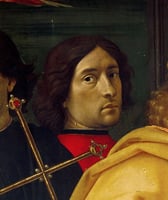
Naturalistic detail and portraiture: The faces of the Magi and bystanders are rendered with remarkable individuality, many believed to be portraits of contemporary Florentine citizens or members of the commissioning family (the Tornabuoni or Sassetti). Ghirlandaio’s skill at capturing textures—fur, silk, jewels, and the humble straw of the manger—grounds the divine scene in tangible reality, reflecting the humanist interest in the physical world.
-
Integration of patron and piety: By including donors and onlookers dressed in contemporary Florentine garb, Ghirlandaio makes the biblical episode a living event. This practice, common in Renaissance altarpieces, reinforced the connection between the sacred and the civic, and foreshadowed the even more complex narrative frescoes Ghirlandaio would later execute in Santa Maria Novella.
-
Influence on Michelangelo: Young Michelangelo reportedly studied Ghirlandaio’s use of drapery and facial expression; the rich, volumetric figures in this Adoration—especially the kneeling Magi—demonstrate the sculptural modeling that Michelangelo would later push further.
In short, Ghirlandaio’s Adoration of the Magi is significant as a refined synthesis of precise observation, linear perspective, and devotional storytelling—a work that both celebrates the Early Renaissance’s technical advances and offers a vivid window into the society for which it was made.
Museum / Gallery
Visivamente simili
20 opere con composizione e palette affini
Disputation in the Synagogue
Filippo Lippi
Allegory of March – Triumph of Minerva and Sign of Aries. Frescos in Palazzo Schifanoia (detail)
Francesco del Cossa
Presentation of the Virgin
Domenico Ghirlandaio
St. John Taking Leave of his Parents
Filippo Lippi
Raising of Drusiana
Giotto
The Annunciation
Domenico Ghirlandaio
The Martyrdom of St. Stephen
Filippo Lippi
Tabernacle of the Madonna delle Tosse: Assumption of the Virgin
Benozzo Gozzoli
Portrait of the Donor Giovanni Tornabuoni
Domenico Ghirlandaio
View of east wall of the chapel
Fra Angelico
Zacharias Writes Down the Name of His Son
Domenico Ghirlandaio
Preaching of St. John the Baptist
Domenico Ghirlandaio
Blessing of the Faithful at Hippo
Benozzo Gozzoli
Annunciation
Sandro Botticelli
Exaltation of the Cross: Heraclius enters Jerusalem with the Cross
Piero della Francesca
View of the Left Hand Wall of the Chapel
Benozzo Gozzoli
Cappella Rinuccini
Giovanni da Milano
Life of St Benedict, Scene 19. Benedict Sends Away the Harlots
Il Sodoma
The Vintage and Drunkenness of Noah
Benozzo Gozzoli
The Paradise
Luca Signorelli