Expertenanalyse zu Domenico Ghirlandaios Expulsion of Joachim
Stil: Early Renaissance · Genre: religious painting
Expert Analysis: "Expulsion of Joachim" by Domenico Ghirlandaio
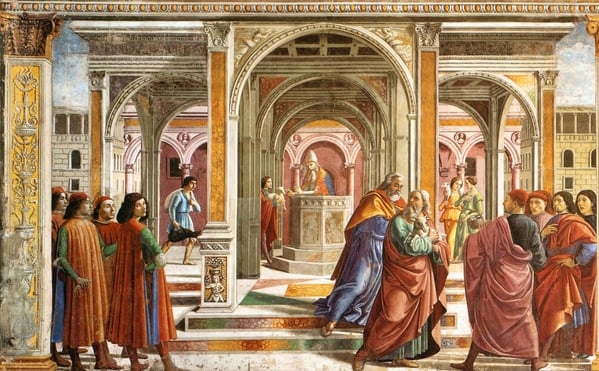
Domenico Ghirlandaio’s Expulsion of Joachim is a masterful example of Early Renaissance religious painting that demonstrates the period’s shift toward naturalism, human emotion, and clear narrative structure. The work depicts the biblical episode from the apocryphal Gospel of James in which Joachim, the father of the Virgin Mary, is driven from the Temple because of his childlessness—a scene that prefigures themes of divine grace and redemption.
Significance within the Early Renaissance:
-
Narrative Clarity and Emotional Realism
Ghirlandaio excels at telling a story through gesture and expression. Joachim’s downcast eyes, hunched posture, and the priest’s dismissive hand communicate shame and rejection without melodrama. The figures are solidly three-dimensional, their drapery falling in natural folds that reveal the body beneath—a hallmark of Early Renaissance humanism influenced by Masaccio. -
Integration of Contemporary Florentine Life
Although the subject is sacred, Ghirlandaio sets the scene in a recognizable Florentine public space, complete with classical architecture, a tiled pavement, and even a glimpse of a distant landscape. This blending of the biblical with the contemporary allowed viewers to see their own city reflected in holy history, making the spiritual message intimate and immediate. -
Spatial Organization and Perspective
The composition uses a clear one-point perspective, with the vanishing point near the center of the Temple doorway. Diagonal lines of the pavement lead the eye directly to the expelled Joachim, emphasizing his isolation. This mathematical approach to space, typical of Ghirlandaio and his contemporaries, gives the painting a rational, ordered structure that mirrors the Renaissance belief in harmony and proportion. -
Attention to Detail and Surface Texture
Ghirlandaio was renowned for his meticulous rendering of materials—the marble of the Temple, the rich fabrics of the priests’ vestments, the rough wool of Joachim’s tunic. Such virtuosity not only demonstrates technical skill but also grounds the supernatural in tangible reality, a key ambition of Early Renaissance art.
Legacy: This panel is part of a larger altarpiece or predella cycle—possibly from Ghirlandaio’s work for the Church of Santa Maria Novella or another Florentine institution—and it exemplifies how artists of the era used narrative cycles to educate and inspire. Its combination of dignified human emotion, precise perspective, and everyday Florentine detail makes Expulsion of Joachim a poignant and intellectually engaging work that bridges the late Gothic tradition and the full flowering of the Renaissance.
Museum / Gallery
Visuell ähnlich
20 Werke mit ähnlicher Komposition und Farbpalette
Marriage of Mary
Domenico Ghirlandaio
Zacharias Writes Down the Name of His Son
Domenico Ghirlandaio
Presentation of the Virgin
Domenico Ghirlandaio
Three Scenes from the Story of Esther
Sandro Botticelli
The School of Tagaste
Benozzo Gozzoli
Angel Appearing to Zacharias
Domenico Ghirlandaio
The School of Tagaste
Benozzo Gozzoli
The Birth of Mary
Domenico Ghirlandaio
Esther Choisie Par Assuérus
Filippino Lippi
The Annunciation
Francesco del Cossa
Annunciation
Filippo Lippi
Portrait of the Donor Giovanni Tornabuoni
Domenico Ghirlandaio
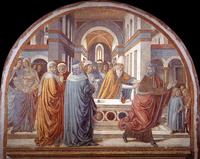
Tabernacle of the Visitation: Expultion of Joachim from the Temple
Benozzo Gozzoli
Scenes from the Life of Saint Zenobius
Sandro Botticelli
Thomas Und Matthias Altar
Bernard Van Orley
Annunciation with Saint Emidius
Carlo Crivelli
The Annunciation
Vittore Carpaccio
Scene from the Life of Moses
Sandro Botticelli
The Annunciation
Pietro Perugino
Life of St Benedict, Scene 19. Benedict Sends Away the Harlots
Il Sodoma