The Crucifixion and the Glorification the Ten Thousand Martyrs on Mount Ararat
Dettagli
Analisi esperta di The Crucifixion and the Glorification the Ten Thousand Martyrs on Mount Ararat di Vittore Carpaccio
Stile: High Renaissance · Genere: religious painting
Expert Analysis: "The Crucifixion and the Glorification of the Ten Thousand Martyrs on Mount Ararat" by Vittore Carpaccio
As a defining work of the High Renaissance, Carpaccio’s monumental religious painting fuses the period’s ideals of emotional gravity, complex composition, and naturalistic detail with a uniquely Venetian sensibility for color and narrative spectacle. The artwork’s significance lies in its masterful integration of horror and transcendence—a hallmark of High Renaissance religious art, which sought to make divine truths tangible through human drama.
Stylistic and Period Significance
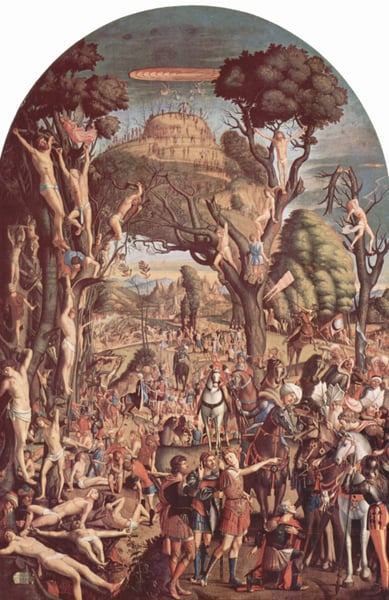
- High Renaissance Grandeur: The painting demonstrates the era’s ambition to synthesize multiple figures, dramatic perspective, and atmospheric depth into a unified, harmonious whole. Carpaccio organizes the vast, chaotic scene of martyrdom—ten thousand Roman soldiers crucified on Mount Ararat—around a central vertical axis: the crucified Christ flanked by the bleeding martyrs, their bodies echoing His sacrifice. This hierarchical composition, rooted in classical symmetry, elevates the gruesome subject to a cosmic glorification.
- Venetian Color and Light: Unlike the linear precision of Florentine High Renaissance, Carpaccio employs Venetian colorito—rich, luminous hues (deep reds, golds, and azure skies) that seem to glow from within. The landscape of Mount Ararat is rendered with atmospheric perspective, softening the violence into a panoramic, almost dreamlike vista. This use of light and color transforms the massacre into a vision of martyrdom as triumphant, not merely tragic.
- Narrative Detail and Devotional Intensity: Every corner of the canvas teems with micro-narratives: soldiers being nailed, bodies hanging, angels descending with crowns and palms. Carpaccio’s trademark precision—from armor to foliage—makes the supernatural feel vividly real, engaging the viewer in a meditative contemplation of faith and sacrifice. This careful storytelling aligns with the High Renaissance aim to instruct and inspire the faithful through visually compelling history.
What Makes It Significant
- Scale and Ambitious Iconography: Depicting ten thousand martyrs required Carpaccio to manage an unprecedented number of figures while maintaining clarity and emotional impact. The painting becomes a triumph of crowd composition—each cluster of martyrs reads as a distinct unit, yet the whole feels orchestrated, reflecting the High Renaissance belief in art as a microcosm of divine order.
- Psychological Complexity: The work does not shy from brutality but places it within a framework of glorification. Christ’s own crucifixion at the apex ties the martyrdom to the central mystery of Christianity: suffering as path to salvation. The juxtaposition of anguish and radiance—some martyrs writhing, others serene—captures the era’s fascination with human emotion as a window into the soul.
- Cultural Synthesis: While rooted in biblical legend (the Ten Thousand Martyrs of Mount Ararat), Carpaccio infuses the scene with contemporary Venetian elements—the soldiers’ armor, the landscape’s evocation of the Alps or Dalmatian coast—making the sacred story resonate with his own audience. This blending of the timeless and the immediate epitomizes the High Renaissance’s ambition to speak to both the divine and the human.
In sum, this painting is a remarkable example of High Renaissance religious art that seamlessly unites narrative richness, compositional mastery, and spiritual urgency. It stands as a testament to Carpaccio’s ability to turn a grim historical legend into a luminous, devotional masterpiece, affirming the period’s conviction that art could reveal the eternal within the temporal.
Visivamente simili
20 opere con composizione e palette affini
The Martirydom of Saint Sebastian
Antonio del Pollaiolo
Procession of the Magus Balthazar (detail)
Benozzo Gozzoli
Procession of the Oldest King
Benozzo Gozzoli
The Crucifixion
Luca Signorelli
The Martyrdom of the Pilgrims and the Funeral of St. Ursula, from the St. Ursula Cycle, 1490-94
Vittore Carpaccio
Das Martyrium Des Hl. Sebastian (Sebastiansaltar)
Hans Holbein the Elder
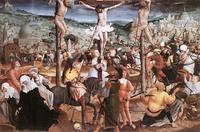
Crucifixion
Jan Provoost
The Story of Nastagio degli Onesti (I), from The Decameron, by Boccaccio
Sandro Botticelli
Landschaft Mit St. Georg
Joseph Anton Koch
The Rape of the Sabine Women
Il Sodoma
Christ Carrying the Cross
Pieter Brueghel the Younger
The Story of Nastagio
Sandro Botticelli
The Martyrdom of St. Jacques
Andrea Mantegna
Minerva Chasing the Vices from the Garden of Virtue
Andrea Mantegna
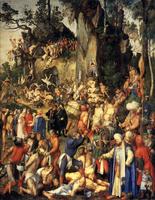
Martyrdom of the Ten Thousand
Albrecht Durer
April. Fresco in Palazzo Schifanoia (detail)
Francesco del Cossa
Aeneas and the Sibyl in the Underworld
Jan Brueghel the Younger
Altar polyptych of San Bartolomeo, Bergamo, foot plate: Martyrdom of St. Stephen
Lorenzo Lotto
Aeneas and the Sibyl in the Underworld
Jan Brueghel the Younger
The Martyrdom of St. Sebastian
Luca Signorelli