Expertenanalyse zu Hans Baldungs Holy Family in the room with five angels
Stil: Northern Renaissance · Genre: religious painting
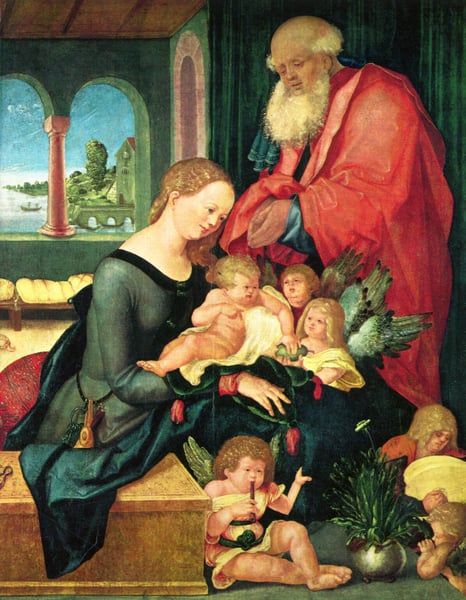
As an expert art historian, I will analyze "Holy Family in the room with five angels" by Hans Baldung (also known as Hans Baldung Grien) within the context of the Northern Renaissance and the religious painting genre.
Significance in the Northern Renaissance
Hans Baldung was a preeminent pupil of Albrecht Dürer, and his work represents a distinct and often emotionally charged branch of the Northern Renaissance. While the Northern Renaissance is celebrated for its meticulous realism and symbolic detail, Baldung’s contribution lies in his ability to infuse those qualities with a heightened sense of psychological tension, expressive color, and a uniquely personal, sometimes eerie, spirituality. This painting is significant precisely because of how it reimagines a traditional religious subject.
1. The Intimate, Domestic Setting: Unlike many High Renaissance depictions of the Holy Family set in grand architectural ruins or idyllic landscapes, Baldung places the sacred family in a common "room." This domestic setting is a hallmark of Northern Renaissance piety, making the divine accessible and human. The room itself is not just a background; it creates a sense of enclosure and immediate, tangible presence. The "five angels" are not celestial beings floating on clouds; they are active participants within this domestic sphere, bringing the heavenly into the earthly household in a way that was deeply resonant with Northern devotional practices.
2. Baldung’s Expressive and Emotional Palette: Baldung’s color choices are often more vivid, acidic, and emotionally charged than those of his teacher Dürer. In this work, the significance lies in how color and light shape the mood. The interaction between the warm, human tones of Mary and Joseph and the perhaps luminous, otherworldly presence of the angels creates a dynamic tension. This is not a static, serene Holy Family; it is a relational moment, often characterized by Baldung with a sense of maternal protectiveness and infant vulnerability that feels almost palpably real.
3. The Role and Nature of the Angels: The specific inclusion of "five angels" is notable. In Baldung’s oeuvre, angels are not always passive witnesses; they are often active, curious, and intensely focused on the Christ Child. This focus reflects the Northern Renaissance’s emphasis on the Incarnation—the Word made flesh. The angels’ reactions serve to guide the viewer’s own emotional and spiritual response, creating a layered devotional experience. Baldung’s angels often possess a childlike or androgynous quality, adding to the work's sense of otherworldly intimacy.
4. A Synthesis of German Tradition and Personal Vision: What makes this work significant within the period is how Baldung synthesizes the Northern tradition of precise, symbolic detail with his own personal vision. Where a contemporary like Dürer might emphasize perfect linearity and classical balance, Baldung is more interested in atmospheric effects, emotional resonance, and a certain "Gothic" rusticity. This painting likely demonstrates his mastery of chiaroscuro and his love for complex folds of drapery—a technical hallmark of Northern painting—but rendered with a softer, more painterly touch than his earlier work.
Conclusion:
"Holy Family in the room with five angels" is significant not because it breaks with tradition, but because it personalizes and humanizes it. In the context of the Northern Renaissance, it stands as an exemplar of how religious art could become a vehicle for intimate emotional expression. Baldung transforms a canonical biblical narrative into a private, domestic devotion—a room filled with the palpable presence of the holy, seen through the lens of a deeply individual and expressive artistic temperament. It is a masterful example of the Northern Renaissance’s enduring power to find the sacred in the specific, the heavenly in the humble room.
Visuell ähnlich
20 Werke mit ähnlicher Komposition und Farbpalette
The Mystic Marriage of St. Catherine
Lucas Cranach the Elder
The Holy Family
Lucas Cranach the Elder
The Holy Family
Martin Schongauer
Holy Conversation
Giovanni Bellini
Madonna and Child with an Angel
Sandro Botticelli
The Esterhazy Madonna
Raphael
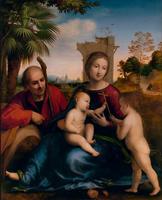
The Rest on the Flight into Egypt with St. John the Baptist
Fra Bartolomeo
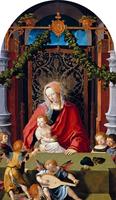
Virgin and Child with Angels
Lucas van Leyden
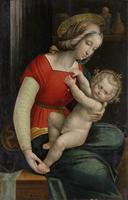
Madonna and Child
Defendente Ferrari
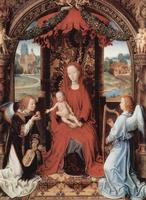
Madonna and Child Enthroned with Two Angels
Hans Memling
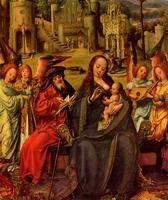
Holy Family with St. Catherine and St. Barbara
Mabuse
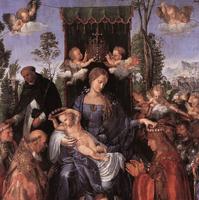
The Lady of the festival du Rosaire(fragment)
Albrecht Durer
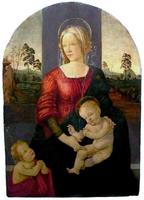
Madonna and Child with St. John the Baptist
Sandro Botticelli
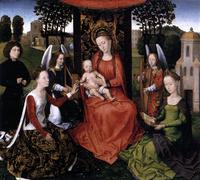
Mystic marriage of St Catherine
Hans Memling
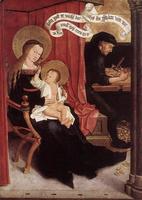
Mary and Joseph with Jesus
Bernhard Strigel
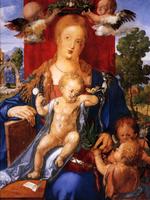
Madonna with the Siskin
Albrecht Durer
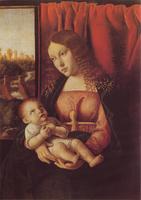
Madonna Con Il Bambino
Bartolomeo Veneto
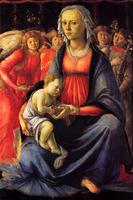
The Virgin and Child surrounded by Five Angels
Sandro Botticelli
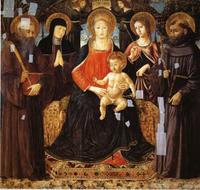
Madonna and Child Enthroned Among St. Benedict, St. Scholastica, St. Ursula and St. John Gualberto
Benozzo Gozzoli
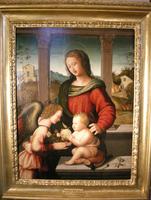
Virgin and Child with Angel
Mariotto Albertinelli