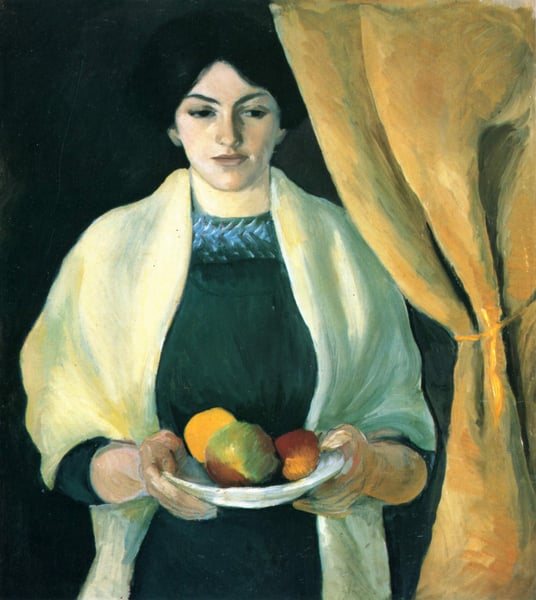
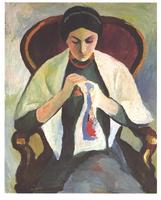
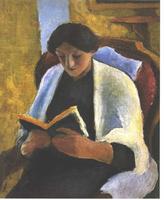
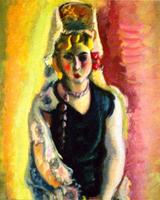
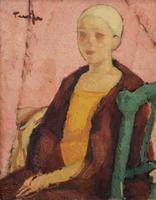
This portrait, Portrait with Apples (Portrait of the Artist’s Wife) by August Macke, exemplifies the core tenets of Expressionism through its bold synthesis of intimate portraiture and symbolic still life. Within the Expressionist movement, Macke distinguished himself by translating emotional states into vibrant, often non-naturalistic color harmonies rather than relying on dramatic distortion or anguish. Here, the apples are not mere accessories but serve as a key compositional and symbolic device: their rounded forms and vivid hues echo the sitter’s face and dress, creating a rhythmic unity that blurs the boundary between figure and object. This integration of still-life elements into a portrait was a hallmark of Macke’s mature period, reflecting the influence of French Fauvism and the German Blaue Reiter group’s interest in spiritual expression through color. The painting’s significance lies in how it demonstrates Expressionism’s capacity for joy and domestic intimacy, countering the movement’s more commonly cited angst. By flattening spatial depth and simplifying forms into patches of pure color, Macke achieves a decorative yet deeply personal resonance, marking a distinct contribution to early 20th-century modernism.