Expertenanalyse zu Berthe Morisots Conversation
Stil: Impressionism · Genre: genre painting
Expert Analysis: "Conversation" by Berthe Morisot
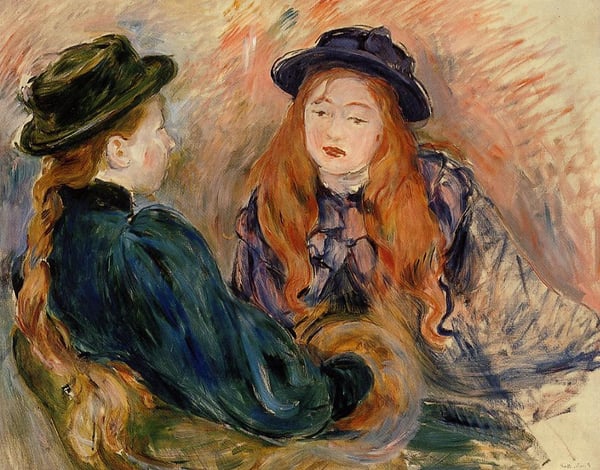
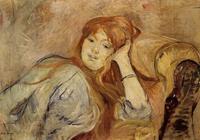
Berthe Morisot’s Conversation (c. 1874–1885) stands as a quintessential example of Impressionism’s radical reimagining of modern life, filtered through a distinctly feminine lens. The painting belongs to the genre of genre painting—a depiction of everyday, intimate scenes—yet it elevates the domestic sphere into a site of profound aesthetic and social significance.
Stylistic Significance within Impressionism
Morisot’s technique exemplifies Impressionism’s core tenets: loose, visible brushstrokes that capture fleeting moments and the transient effects of light. In Conversation, the artist employs a rapid, feathery application of paint, particularly in the figures’ dresses and the background foliage, to evoke the shimmering atmosphere of a sunlit garden. The palette is light and airy—soft whites, pale blues, muted greens—with dabs of pink and lavender that suggest the interplay of sunlight and shadow. Rather than delineating sharp outlines, Morisot lets color and texture define form, dissolving the boundaries between figures and their environment. This approach aligns with the Impressionist goal of recording a “snapshot” of sensory experience, prioritizing perception over precise draftsmanship.
The Feminine Gaze and Modern Life
Morisot was a pioneering female member of the Impressionist circle. Conversation reflects her unique perspective: it depicts two women in quiet, absorbed dialogue, an intimate moment often overlooked by male Impressionists, who favored cafes, boulevards, or theatrical entertainments. The absence of dramatic action or explicit narrative shifts focus to the psychological exchange between the figures—a subtle, unspoken bond. By centering women’s private sociability, Morisot challenges both academic hierarchies (which dismissed such scenes as trivial) and the male gaze, presenting women not as objects but as subjects of their own experience. The work thus contributes to a redefinition of “modern life” to include the interior, relational world of women.
Legacy and Influence
Conversation is significant as a marker of Morisot’s mastery of plein-air spontaneity and her ability to infuse a traditional genre—domestic conversation—with Impressionist vitality. It rejects sentimentality in favor of an almost ephemeral elegance, capturing a moment that feels both fleeting and eternal. Today, the painting is celebrated not only for its technical brilliance but for expanding the boundaries of Impressionist subject matter, asserting that the quiet, everyday moments of women’s lives are worthy of the same artistic reverence as urban spectacles. In doing so, Morisot carved a space for female vision within one of art history’s most revolutionary movements.
Museum / Gallery
Visuell ähnlich
20 Werke mit ähnlicher Komposition und Farbpalette
Young Woman and Child, Avenue du Bois
Berthe Morisot
Susan in a Toque Trimmed with Two Roses
Mary Cassatt
Two Girls in Black
Pierre-Auguste Renoir
The Black Finger Bandage
Berthe Morisot
Boating Couple (Aline Charigot and Renoir)
Pierre-Auguste Renoir
Little Girl with a Doll
Berthe Morisot
The Little Reader (Little Girl in Blue)
Pierre-Auguste Renoir
At the Milliner`s
Pierre-Auguste Renoir
Two girls
Pierre-Auguste Renoir
Two Sisters
Pierre-Auguste Renoir

Young Girl Holding at Bouquet of Tulips
Pierre-Auguste Renoir
At the Milliner`s (study)
Pierre-Auguste Renoir
Young Woman in a Straw Hat
Pierre-Auguste Renoir
Portrait of Mary Cassatt
Edgar Degas
Portrait of Miss Cassatt, holding the cards
Mary Cassatt
The Reading
Pierre-Auguste Renoir
The Two Sisters
Mary Cassatt
Jeannie Gobillard
Berthe Morisot
Reading the Part
Pierre-Auguste Renoir
Young Girl Leaning on her Elbow
Berthe Morisot