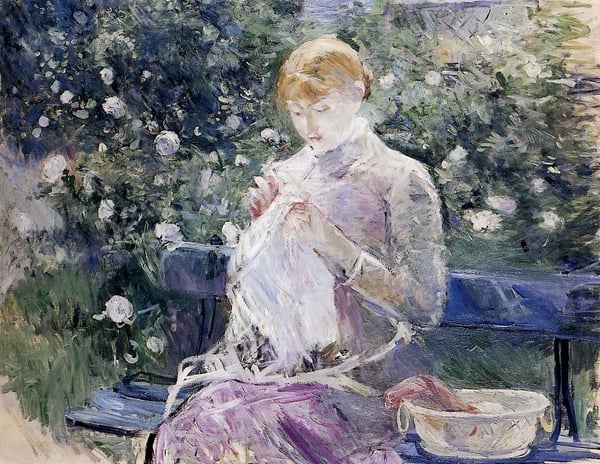
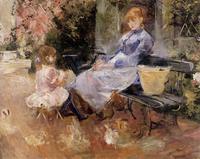
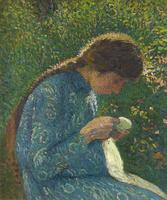
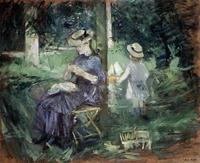
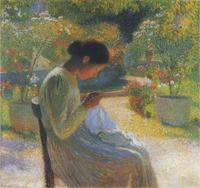
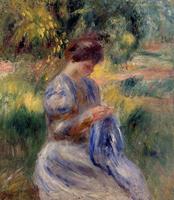
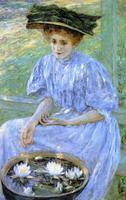
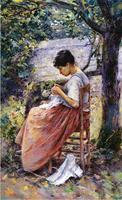
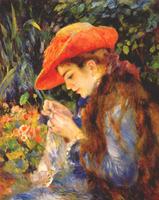
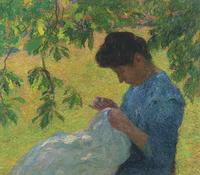
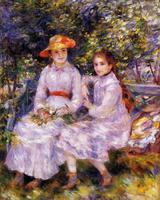
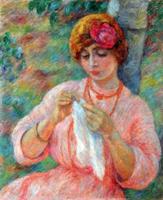
Berthe Morisot’s Pasie Sewing in Bougival’s Garden is a quintessential Impressionist genre painting that exemplifies the movement’s dedication to capturing fleeting moments of everyday life.
The work is significant for its intimate, domestic subject—a woman engaged in the quiet, mundane act of sewing—which aligns with Morisot’s frequent focus on the private world of women and children, a theme that distinguished her within the male-dominated Impressionist circle. The setting in Bougival, a rural suburb favored by Impressionists for its natural light, allows Morisot to explore the interplay of sunlight and shadow through loose, rapid brushstrokes and a bright, airy palette.
By elevating a simple, unposed scene to a subject worthy of fine art, Morisot challenges traditional hierarchies of genre painting. Her treatment of the figure and garden merges the sitter with her surroundings, emphasizing the atmospheric effects of light and color over precise detail—a hallmark of Impressionism. This blending of human activity with nature underscores the movement’s radical focus on modern, lived experience, marking the work as a testament to Morisot’s role in redefining both Impressionist technique and the representation of women’s lives.