Expertenanalyse zu Berthe Morisots Swans
Stil: Impressionism · Genre: animal painting
Expert Analysis of "Swans" by Berthe Morisot
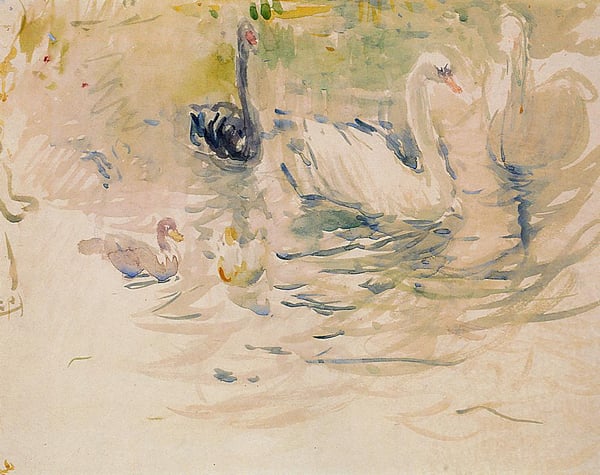
Berthe Morisot’s Swans occupies a distinctive place within Impressionist animal painting, a genre more often associated with artists like Degas (horses) or Manet (cats). As one of the few female founders of Impressionism, Morisot brought a uniquely intimate, lyrical sensibility to her subjects. Here, the swans are not rendered as majestic symbols or narrative props; instead, they are treated as fleeting impressions of light, water, and motion.
The painting exemplifies the core Impressionist concern with capturing the transient effects of atmosphere and reflection. Morisot’s characteristic loose, feathery brushstrokes dissolve the swans’ forms into the shimmering surface of the water, blurring the boundary between creature and environment. The palette is typically light—soft whites, pale grays, and touches of blue-green—evoking a sense of quietude and natural harmony. Unlike the more dramatic or analytical animal studies of her contemporaries, Morisot approaches her subject with a delicate, almost domestic tenderness, transforming the swans into gentle presences that inhabit a world of flickering sunlight and rippling water.
Significance within Impressionism
-
Expanding the Impressionist Subject: Animal painting was relatively rare among the Impressionists compared to landscapes, city scenes, or portraits. Morisot’s Swans demonstrates that the movement’s principles—rapid notation, broken color, emphasis on light—could be powerfully applied to wildlife, treating animals not as static symbols but as living entities caught in a specific moment.
-
Gender and Perspective: As a woman artist in a male-dominated circle, Morisot often focused on private, domestic, or natural scenes. Swans reflects her interest in serene, contemplative motifs, offering a counterpoint to the more urban or theatrical subjects of her male peers. The painting’s gentle observation aligns with the broader Impressionist goal of rendering the “impression” of a scene without academic idealization.
-
Technical Virtuosity: The painting showcases Morisot’s mastery of the wet-on-wet technique and her ability to evoke texture and movement with minimal detail. The swans’ necks curve in swift, confident strokes, while the water is built from layers of short, horizontal dashes of paint. This handling embodies the Impressionist ideal of spontaneity—the sense that the moment itself is being preserved on canvas.
In Swans, Berthe Morisot achieves a quiet revolution: she brings the Impressionist language of light and flux to the animal kingdom, proving that even the most timeless subjects can be made fresh and immediate under an artist’s singular gaze.
Museum / Gallery
Visuell ähnlich
20 Werke mit ähnlicher Komposition und Farbpalette
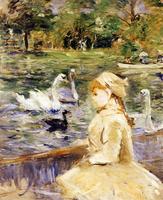
Young girl boating
Berthe Morisot
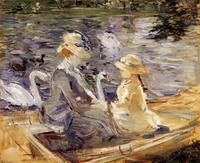
On the Lake in the Bois de Boulogne
Berthe Morisot
Family of Swans
Henri-Edmond Cross
Bathing Goose Maidens
Camille Pissarro
Boating on the Lake
Berthe Morisot
Old Woman with Ducks at Montfoucault
Camille Pissarro
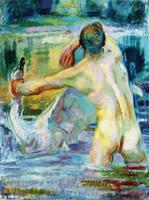
Mies Ja Joutsen
Magnus Enckell
Daughter of Cairo
Wilhelm Kotarbinski
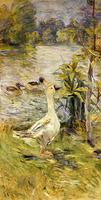
The Goose
Berthe Morisot
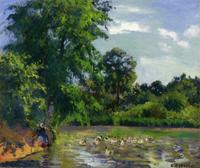
Ducks on the Pond at Montfoucault
Camille Pissarro
A Long Island Lake
William Merritt Chase
Geese
Alfred Sisley
Girl in a Boat, with Geese
Berthe Morisot
Vaszary János, Balatoni Naplemente 1903
Vaszary János
Fantasia
Magnus Enckell
In the Bois de Boulogne
Boris Kustodiev
Goose Girl
Alfred Sisley
Summertime
Mary Cassatt
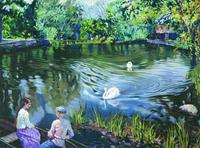
In the Boat
Nikolay Bogdanov-Belsky
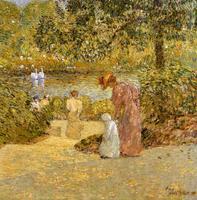
Descending the Steps, Central Park
Childe Hassam