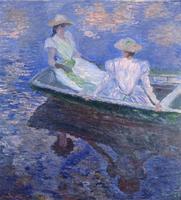
Expert Analysis: "Young Girl Boating" by Berthe Morisot
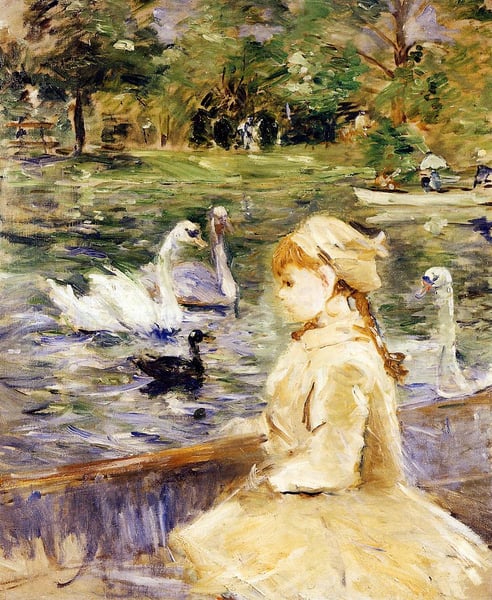
Berthe Morisot’s Young Girl Boating exemplifies the core tenets of Impressionism while simultaneously challenging the movement’s traditional gender boundaries. As a genre painting—a depiction of everyday life—the work captures a fleeting moment of leisurely bourgeois activity, a favorite subject of the Impressionists. Morisot’s significance here lies in her distinctively delicate yet spontaneous brushwork, which animates the surface with dappled light and soft, blurred edges. This technique evokes the shimmering reflections on water and the breeze rustling the girl’s clothing, emphasizing transience rather than static detail.
Crucially, Morisot was one of the few female members of the Impressionist circle, and her focus on intimate, domestic or recreational scenes from a woman’s perspective—here, a young girl alone in a boat—offers a subtle counterpoint to the more overtly public or masculine leisure scenes favored by her male peers. The painting’s significance is thus twofold: it demonstrates the Impressionist commitment to capturing modern life with optical truth, and it asserts the importance of the feminine gaze within the movement, broadening what “modern life” could represent.