Analisi esperta di Bethlehem di Vasily Polenov
Stile: Realism, Orientalism · Genere: cityscape
Expert Analysis: "Bethlehem" by Vasily Polenov
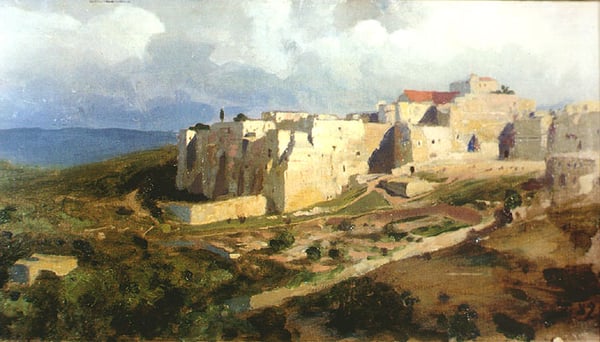
Vasily Polenov’s Bethlehem is a compelling fusion of Realist precision and Orientalist fascination, rendered within the cityscape genre. Painted during a period when European and Russian artists were increasingly drawn to the “Holy Land,” the work stands out for its documentary sobriety—a hallmark of Polenov’s training and artistic philosophy—combined with a romanticized view of the East that typifies Orientalism.
Significance within Realism:
Polenov was a key figure in the Russian realist movement, known for his lyrical landscapes and meticulous observation of light and atmosphere. In Bethlehem, this approach is evident: the architecture, dusty streets, and figures are rendered with palpable authenticity, avoiding overt sentimentalism. The artist’s use of natural light and earthy tones grounds the scene in a specific time and place, reflecting the Realist commitment to capturing everyday life without idealization—even when that life is foreign to his Russian audience.
Significance within Orientalism:
The painting also participates in the 19th-century Orientalist tradition, where Western artists depicted the Middle East as a realm of biblical timelessness and exotic charm. Polenov’s view of Bethlehem is both a “cityscape” and a spiritual pilgrimage tableau. The inclusion of local inhabitants, simple dwellings, and the distant Church of the Nativity situates the work in a real geography, yet the composition subtly elevates the mundane into the sacred. This duality—empirical truth meeting imaginative longing—defines the period’s Orientalist aesthetic.
Artistic Context:
Polenov traveled to Palestine and Syria in 1881–1882, producing a series of studies that culminated in this work. Bethlehem is significant because it bridges two modes: the ethnographic accuracy prized by Realist painters and the exotic allure that made Orientalist works popular in European salons. It avoids the overly dramatic or decadent excesses of some Orientalist peers (such as Jean-Léon Gérôme), instead offering a quiet, almost contemplative view that prioritizes spatial harmony and human scale.
Conclusion:
Bethlehem is noteworthy as a document of cultural encounter—a Russian Realist’s disciplined gaze on a sacred site refracted through Orientalist conventions. Its significance lies in how Polenov reconciles the objective with the picturesque, making the cityscape a touchstone for understanding late-19th-century cross-cultural artistic dialogue.
Visivamente simili
20 opere con composizione e palette affini
View near Vence in the Alpes-Maritimes
Winston Churchill
Jerusalem from the west. Jaffa Gate and the Citadel.
Vasily Polenov
Siena
Pyotr Konchalovsky
View of Mar Saba
Konstantin Gorbatov
Le Tourette
Alexandre Jacovleff
Ydra
Periklis Vyzantios
Ruined Buildings, Naples
Thomas Jones
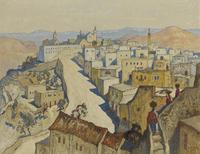
Bethlehem
Konstantin Gorbatov
Landscape from Caseres, Spain
Henri Catargi
Group of houses in Olevano
Heinrich Reinhold
Volterra
Camille Corot
Nazareth at Sunrise
Elizabeth Thompson
A view at Olevano
Heinrich Reinhold
Castellonorato
Antonio Sicurezza
View of Castellonorato
Antonio Sicurezza
Olevano
Albert Bierstadt
The Holy Land
Konstantin Gorbatov
Bethlehem engraving by William Miller after Leitch
William Leighton Leitch
Jerusalem
Konstantin Gorbatov
View of the Fortified Village of Eze
Winston Churchill