Analisi esperta di Early snow. Behovo. di Vasily Polenov
Stile: Realism · Genere: landscape
Expert Analysis of "Early snow. Behovo." by Vasily Polenov
Artist & Style Context:
Vasily Polenov (1844–1927) was a central figure in Russian Realism, known for his intimate, lyrical landscapes that broke from the grand, narrative-driven paintings of earlier generations. His work bridges the academic tradition with the emerging plein air sensibility, emphasizing direct observation of nature and atmospheric effects. "Early snow. Behovo." belongs to his mature period, when he focused on the simple, unspoiled beauty of the Russian countryside near his estate on the Oka River.
Significance within Realism:
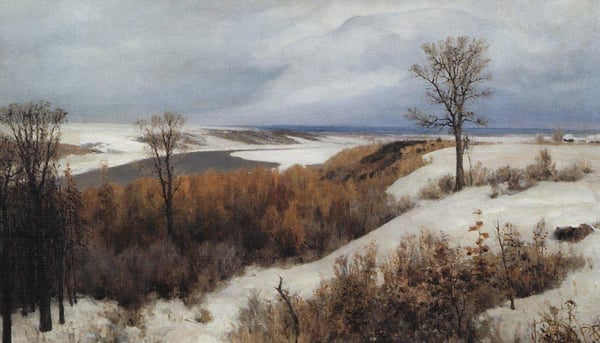
This painting exemplifies the realist commitment to capturing the ordinary, transient moments of everyday life in nature. Rather than depicting a dramatic event or a heroic vista, Polenov selects a quiet, transitional season—the first snowfall—and a modest location (the village of Behovo). The work’s significance lies in its lyrical truthfulness: the soft, muted palette of whites, grays, and earthy browns conveys the hushed stillness of a landscape settling into winter. The subtle gradations of light on the snow and the delicate outlines of bare trees demonstrate Polenov's mastery of plein air observation, a hallmark of the realist method.
Thematic and Stylistic Importance:
"Early snow" is a quintessential example of Polenov’s "mood landscape" (пейзаж настроения), a genre he helped define. Unlike earlier romantic or social-realist scenes, this work finds poetry in the ephemeral—the moment when autumn yields to winter. The composition is unassuming: a low horizon, an expanse of whitened ground, and a band of forest or village rooftops. This horizontality creates a sense of calm and infinity, inviting the viewer into a contemplative experience. The cool, silvery light and the absence of human figures emphasize nature’s quiet agency.
Cultural and Historical Resonance:
Behovo was a real village on the Oka River, where Polenov built a house and studio in 1890. By painting this specific, personal landscape, he contributed to a broader Russian cultural movement that celebrated the countryside as a source of national identity and spiritual renewal. "Early snow. Behovo." thus represents not only a masterful realist technique but also a deeply felt connection to place—a key reason why Polenov’s landscapes are considered foundational to Russian landscape painting.
Conclusion:
The significance of "Early snow. Behovo." lies in its quiet mastery: it transforms a fleeting, ordinary weather event into a timeless meditation on nature, light, and season. As a work of Realism, it eschews drama for authenticity, and as a landscape, it elevates the modest Russian countryside to a subject worthy of profound artistic attention. Polenov’s ability to conjure an entire atmosphere through subtle color and composition makes this painting a landmark of the realist landscape tradition.
Genere
Stile
Visivamente simili
20 opere con composizione e palette affini
Early snow
Vasily Polenov
First Snow
Vasily Polenov
Indian summer
Vasily Polenov
Getting cold. Autumn on the Oka River near Tarusa.
Vasily Polenov
Oyat river
Vasily Polenov
The Frozen Pool, March
Willard Metcalf
Evening. Golden Plyos.
Isaac Levitan
Oka near Tarusa
Vasily Polenov
Winter
Vasily Polenov
Winter in Skit
Mikhail Nesterov
Dnieper River
Volodymyr Orlovsky
Landscape with forest river
Isaac Levitan
A river
Vasily Polenov
Унылая Пора Очей Очарованье
Vitold Byalynitsky-Birulya
Winter Landscape
Aleksey Savrasov
Oka. Evening.
Vasily Polenov
Near the monastery
Ivan Shishkin
Winter road
Aleksey Savrasov
View of Olana in the Snow
Frederic Edwin Church
View of Oka from the western riverbank
Vasily Polenov