Expert analysis of Vasily Polenov’s Fountain of the Virgin Mary in Nazareth
Style: Realism, Orientalism · Genre: genre painting
Expert Analysis: "Fountain of the Virgin Mary in Nazareth" by Vasily Polenov
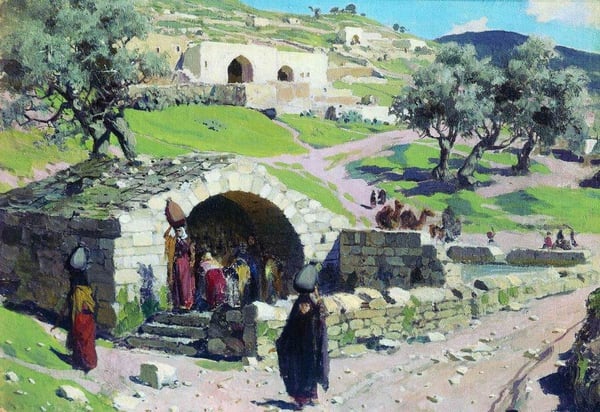
Vasily Polenov’s Fountain of the Virgin Mary in Nazareth is a masterful synthesis of Realist precision and Orientalist curiosity, rendered within the tradition of genre painting. Completed during the artist’s travels through the Middle East in the early 1880s, the work elevates a humble daily scene—women gathering water at a historic well—into a layered meditation on sacred geography and cultural encounter.
Significance in Style and Period:
-
Realist Fidelity – Polenov applies the rigorous observational techniques of Russian Realism to a biblical landscape. The stonework of the fountain, the textures of earthenware jars, and the play of sunlight on whitewashed walls are depicted with documentary accuracy, grounding a legendary site in tangible, lived experience.
-
Orientalist Authenticity – Unlike many Western Orientalists who romanticized the East, Polenov sought ethnographic truth. The figures of local women in simple, flowing garments, the donkey in the background, and the muted earth tones reflect a respectful, almost anthropological gaze. This approach aligns with the period’s growing interest in "ethnographic realism" within Orientalist painting.
-
Religious and Historical Resonance – The fountain is traditionally associated with the Annunciation (where Mary first drew water, according to apocryphal texts). Polenov subtly evokes this sacred narrative not through overt iconography but by depicting ordinary life at the site—a quiet fusion of the holy and the mundane that resonates with the Russian Orthodox tradition of seeing the divine in everyday reality.
-
Genre Painting as Cultural Bridge – By choosing genre (scenes of daily life) over monumental history painting, Polenov makes the Holy Land accessible and human. The viewer is invited to contemplate continuity: the same spring that served Mary now serves the women of Nazareth, linking past and present in a single, unbroken moment.
In this work, Polenov achieves what few of his contemporaries did: a harmonious blend of veristic detail, respectful cultural observation, and spiritual understatement, making Fountain of the Virgin Mary in Nazareth a landmark of late-19th-century Realist-Orientalist art.
Visually similar
20 works with related composition and palette
Marienquelle in Nazaret
Vasily Polenov
Flight into Egypt
Henry Ossawa Tanner
Jesus Heals the Blind and Lame on the Mountain
James Tissot
The Primacy of Saint Peter
James Tissot
Vejen Til Betania
Hans Andersen Brendekilde
Went into the hill country
Vasily Polenov
What People Think about Me
Vasily Polenov
Bethlehem from the Sheepfold, Field of Boaz
Elizabeth Thompson
He Went Through the Villages on the Way to Jerusalem
James Tissot
The Holy Family
Vasily Vereshchagin
Healing of the Lepers at Capernaum
James Tissot
The Miracle of the Loaves and Fishes
James Tissot
Abraham's Servant Meeteth Rebecca
James Tissot
The Taking of Jericho
James Tissot
The Healing of Ten Lepers (Guérison de dix lépreux)
James Tissot
The Holy Women return from Christ's tomb
Pierre Jean Van der Ouderaa
Landscape with ruins
Fyodor Bronnikov
Fountain of the Virgin, Nazareth
David Roberts
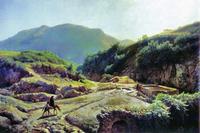
Fountain of Hannibal in Rocca di Papa near Rome
Lev Lagorio
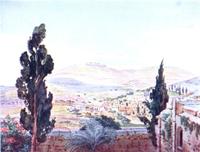
Ain Kareem, reputed birthplace of John the Baptist, from roof of Convent of the Visitation
Elizabeth Thompson