
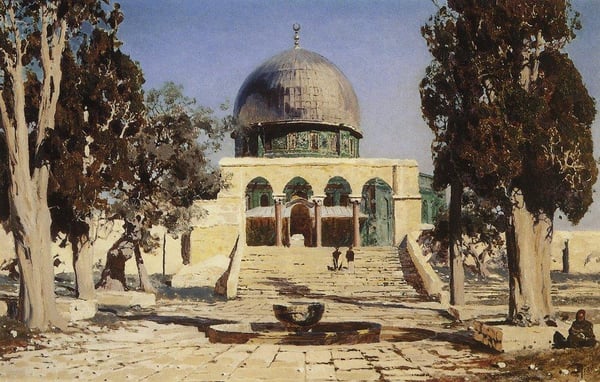
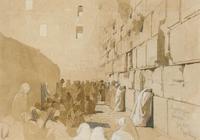
Haram Ash-Sharif - the square where the ancient Temple of Jerusalem was situated
Dettagli
Analisi esperta di Haram Ash-Sharif - the square where the ancient Temple of Jerusalem was situated di Vasily Polenov
Stile: Realism, Orientalism · Genere: cityscape
As an expert art historian, I can provide the following analysis of Vasily Polenov's Haram Ash-Sharif - the square where the ancient Temple of Jerusalem was situated. This work is significant as a masterful synthesis of Realism and Orientalism within the genre of cityscape, executed by one of Russia's foremost late-19th-century painters.
Significance within Realism and Orientalism:
Polenov, a leading member of the Peredvizhniki (The Wanderers), brought the movement's core principles—truthful observation of nature and a rejection of academic artifice—to the Holy Land. Instead of a romanticized, imaginary Jerusalem, he presents a meticulously observed, sun-drenched square. The Realist approach is evident in the clear atmospheric perspective, the precise rendering of stone textures, and the quotidian details of figures resting in the shade. This documentary accuracy grounds the sacred site in tangible, lived reality.
Simultaneously, the work operates firmly within the Orientalist tradition, which captivated European and Russian audiences with scenes of the "exotic" Near East. Polenov selects a site of profound religious and historical weight—the Haram ash-Sharif (Temple Mount). By framing the ancient plaza as a calm, sunlit urban space, he evokes a sense of timelessness and spiritual contemplation, characteristic of Orientalist longing for a pristine, biblical past. The composition, with its strong horizontals and deep shadows, emphasizes the weight of history and the serene majesty of the location.
Why it is significant:
Polenov's painting is a crucial document of 19th-century religious and archaeological tourism, filtered through the disciplined eye of a Realist. It bridges the gap between sacred history and contemporary observation. The work demonstrates the Peredvizhniki ambition to find the eternal in the actual—here, the very stones where the ancient Temple once stood become a subject of both topographical fact and spiritual wonder. This blend of scientific accuracy and Orientalist reverence makes Haram Ash-Sharif a landmark example of how Russian Realism engaged with the Holy Land, offering a view that is both deeply respectful and authentically grounded in the artist's firsthand experience.
Visivamente simili
20 opere con composizione e palette affini
The Mosque of Omar. Haram el-Sharif.
Vasily Polenov
At the Entrance to the Temple Mount, Jerusalem
Gustav Bauernfeind
Jerusalem
Konstantin Gorbatov
View of the Dead Sea from the Temple Square in Jerusalem
Tivadar Kosztka Csontvary
Jerusalem from the South East
Hans Andersen Brendekilde
Supposed Site of the Temple
James Tissot
Jerusalem from the Road Leading to Bethany
David Roberts
Jerusalem from the Mount of Olives
Frederic Edwin Church
The Mount of Olives in Jerusalem
Tivadar Kosztka Csontvary
Jerusalem from the Mount of Olives
David Roberts
Jerusalem
Konstantin Gorbatov
Jerusalem Seen from the South
Avigdor Arikha
The Gate of the Great Umayyad Mosque, Damascus
Gustav Bauernfeind
Study for The Jews' Wailing Place
Henry Ossawa Tanner
Christ and the Sinner
Vasily Polenov
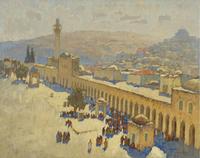
Arches
Konstantin Gorbatov
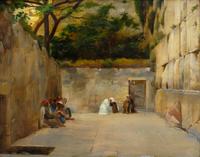
The Wailing Wall, Jerusalem
Théodore Ralli
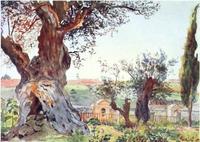
In the Garden of Gethsemane. Noonday. Looking towards Valley of Jehoshaphat
Elizabeth Thompson
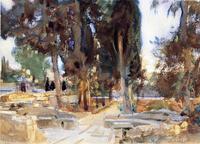
Jerusalem
John Singer Sargent
The Wailing Wall, Jerusalem
Carl Haag