
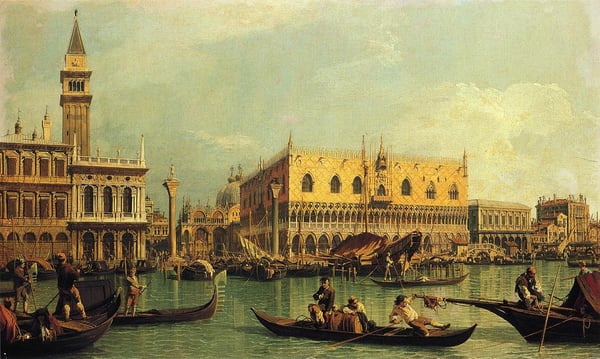
Expertenanalyse zu Canalettos Piazzetta and the Doge's Palace from the Bacino di San Marco
Stil: Baroque · Genre: veduta
Expert Analysis: "Piazzetta and the Doge's Palace from the Bacino di San Marco" by Canaletto
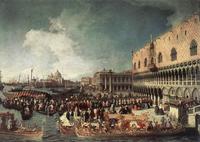
As a defining work of the Baroque veduta—a genre dedicated to highly detailed, topographically accurate city views—Canaletto’s painting exemplifies the period’s fascination with grandeur, precision, and theatrical perspective. The scene captures the iconic heart of Venice from the Bacino di San Marco, a vantage point that emphasizes both the spatial majesty of the Piazzetta and the imposing, ornate façade of the Doge’s Palace.
Significance within the Baroque and Veduta Tradition
-
Mastery of Atmospheric Perspective: Canaletto employs the Baroque device of deep recession into space, drawing the viewer’s eye from the bustling waterfront across the calm waters of the basin toward the architectural ensemble. The play of light on the palace’s white Istrian stone and the subtle gradations of sky and water reflect the Baroque interest in naturalism and optical illusion.
-
Topographical Precision as Art: Unlike idealized or mythological cityscapes, this veduta is a near-documentary record, yet it is elevated by Canaletto’s meticulous brushwork and compositional balance. Each window, arch, and column of the Doge’s Palace is rendered with scientific exactness, a hallmark of the genre that made Canaletto the preferred painter for Grand Tour travelers seeking faithful souvenirs of Venice’s splendor.
-
Narrative of Civic Power: The work simultaneously celebrates Venetian maritime might and republican governance. The juxtaposition of the open Piazzetta (a public political space) with the Doge’s Palace (the seat of government) and the basin (a gateway to trade) creates a layered Baroque allegory of order, prosperity, and dominion. The inclusion of gondolas, figures, and distant sailboats animates the scene without distracting from the architectural focal point, a balance typical of Canaletto’s mature style.
-
Defining the Veduta for a Cosmopolitan Audience: Canaletto’s paintings, including this one, codified the veduta as a serious artistic genre within Baroque painting. His ability to merge cartographic accuracy with painterly beauty set a standard that influenced generations of view painters and solidified Venice’s image as the quintessential city of art and power.
In summary, the significance of this work lies in its perfect synthesis of Baroque theatricality and veduta fidelity—a luminous, controlled vision that transformed a specific urban scene into an enduring emblem of Venetian identity and artistic virtuosity.
Museum / Gallery
Visuell ähnlich
20 Werke mit ähnlicher Komposition und Farbpalette
The Doge's Palace with the Piazza di San Marco
Canaletto
The Bucintore Returning to the Molo on Ascension Day
Canaletto
The Molo and the Piazzetta San Marco, Venice
Canaletto
View of the St. Mark's Basin
Canaletto
Return of the Bucentoro to the Molo on Ascension Day
Canaletto
The Bucintoro by the Molo on Ascension Day
Canaletto
Riva degli Schiavoni Looking East
Canaletto
Venice Veduta
Bernardo Bellotto
Riva degli Schiavoni: Looking East
Canaletto
The Molo, Venice, from the Bacino di San Marco
Luca Carlevaris
Vista de Venicia
Gustaf Wilhelm Palm
Palace rains in Venice by moonlight
Ivan Aivazovsky
Veduta di Venezia con Palazzo Ducale
Luca Carlevaris
Reception of the Imperial Ambassador at the Doge's Palace
Canaletto
View of the Ducal Palace
Canaletto
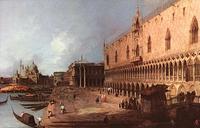
Doge's Palace
Canaletto
Venice
Carl Ludwig Hoffmeister
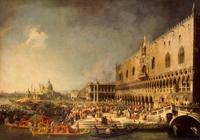
The Reception of the French Ambassador in Venice
Canaletto
Plazzo Ducale (Venice)
Giorgio de Chirico
Reception of the Ambassador in the Doge's Palace
Canaletto