Analisi esperta di Portrait of Dr. Huggler di Ernst Ludwig Kirchner
Stile: Expressionism · Genere: portrait
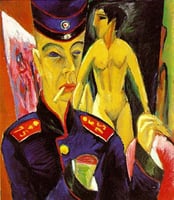
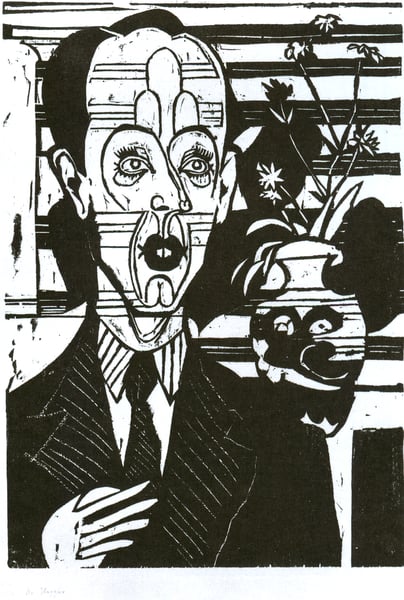
While the facts provided are limited, the significance of "Portrait of Dr. Huggler" by Ernst Ludwig Kirchner can be understood through the lens of its Expressionist style and the artist’s pivotal role in the movement.
Artwork: Portrait of Dr. Huggler
Artist: Ernst Ludwig Kirchner (1880–1938)
Style: Expressionism
Genre: Portrait
Expert Analysis
As a leading member of the Die Brücke group, Kirchner rejected naturalistic representation in favor of psychological intensity. This portrait exemplifies key Expressionist ambitions:
-
Distortion for Emotion: Rather than capturing a literal likeness, Kirchner likely exaggerated Dr. Huggler’s features—elongating the face, sharpening angles, or using unnatural colors—to convey inner turmoil or a sense of alienation. Such distortions were Kirchner’s hallmark, reflecting the anxiety of modern urban life before and during World War I.
-
Color as Symbol: Expressionist portraits often used jarring, non-local colors. In this work, bold juxtapositions (e.g., acidic greens, deep blues, or harsh reds) would not describe the sitter’s skin or clothing, but rather evoke a subjective mood—perhaps tension, intellect, or melancholy.
-
Dynamic Brushwork: Kirchner’s energetic, jagged strokes create a restless surface, pulling the viewer into the sitter’s psychological state. This technique, derived from German Gothic woodcuts and African art, breaks from academic smoothness to express raw emotion.
Significance
-
Context within Expressionism: This painting embodies the movement’s core belief: that art should express the artist’s inner feelings, not outer reality. Kirchner’s portrait of Dr. Huggler is not a neutral document of a person but a visceral encounter with the sitter’s (and artist’s) emotional life.
-
Break from Tradition: In rejecting the calm, idealized portraits of the 19th century, Kirchner redefined portraiture for the modern age—making it a vehicle for existential unease. Works like this influenced later developments in Neo-Expressionism and figurative art.
-
Artist’s Personal Vision: Kirchner suffered from mental health struggles, and his portraits often verge on the grotesque or brutal, reflecting his own fragile psyche. Portrait of Dr. Huggler stands as a testament to Expressionism’s raw honesty and its refusal to beautify discomfort.
In sum, the significance of this artwork lies in how it compresses the core principles of Expressionism—emotional truth over physical accuracy, bold distortion over polite observation—into a single, charged human face.
Visivamente simili
20 opere con composizione e palette affini
Man's Head. Self-portrait
Ernst Ludwig Kirchner
Self-portrait
Ernst Ludwig Kirchner
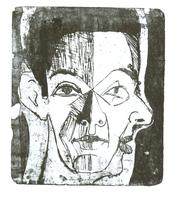
Study of a Head
Ernst Ludwig Kirchner
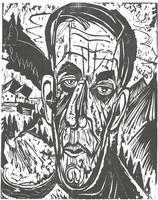
Portrait of Van de Velde
Ernst Ludwig Kirchner
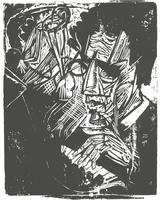
Portrait of the Conductor and Composer Otto Klemperer
Ernst Ludwig Kirchner
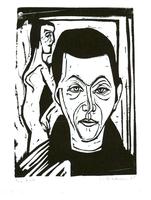
Man's Head. Self-portrait
Ernst Ludwig Kirchner
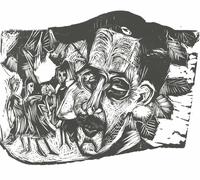
Portrait of Dr. Ludwig Binswanger
Ernst Ludwig Kirchner
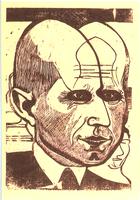
Head of Dr. Bauer
Ernst Ludwig Kirchner
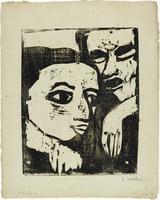
Two People
Erich Heckel
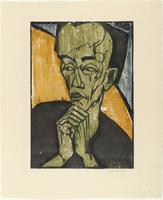
Portrait of a Man
Erich Heckel
Self Portrait
Josef Capek
Donna Nella Notte
Ernst Ludwig Kirchner
Portrait of a man
Theo van Doesburg
Head of Dr. Bauer
Ernst Ludwig Kirchner
Self Portrait II
Jean Dubuffet
Nervous People Eating
Ernst Ludwig Kirchner
Alexei Kruchenykh
Mikhail Larionov
Portrait of Michel Leris
Francis Bacon
Self Portrait II
M.C. Escher
Tete the Clown
Bernard Buffet