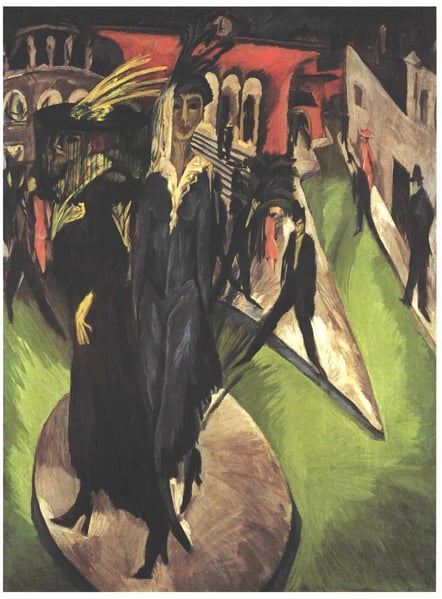
Potsdamer Platz
Expert analysis of Ernst Ludwig Kirchner’s Potsdamer Platz
Style: Expressionism · Genre: genre painting
Expert Analysis of "Potsdamer Platz" by Ernst Ludwig Kirchner
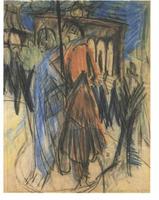
As a defining work of German Expressionism, Ernst Ludwig Kirchner’s Potsdamer Platz (1914) exemplifies the movement’s radical departure from Impressionist naturalism and its embrace of subjective emotion, psychological intensity, and urban alienation. Kirchner, a founding member of the Dresden-based group Die Brücke (The Bridge), sought to dismantle academic conventions and instead channel the raw, often disquieting energy of modern life.
In this genre painting—a scene of everyday urban existence—Kirchner transforms Berlin’s bustling Potsdamer Platz into a claustrophobic, jagged geometry of figures and architecture. The composition’s signature characteristics include sharp, angular lines, distorted perspective, and clashing, non-naturalistic colors (acidic greens, hot yellows, and deep blacks). These formal choices are not mere stylization; they are expressive devices that convey the anxiety, fragmentation, and anonymity of the modern metropolis. The figures—hollow-eyed, mask-like pedestrians—appear isolated even in the crowd, their elongated, spiky forms echoing the dehumanizing pace of city life.
What makes Potsdamer Platz significant is its radical synthesis of primitivist influence and contemporary urban anxiety. Kirchner borrows from African and Oceanic art (simplified features, flat planes) and fuses them with the fractured space of Fauvism and early Cubism, yet his goal is not formal abstraction but psychological truth. The painting stands as a visceral premonition of the alienation and dislocation that would come to define the Weimar Republic and, more broadly, the human condition in the 20th century.
Within the Expressionist canon, this work is a quintessential example of how genre painting was elevated from mere documentation to a vehicle for existential critique. Kirchner’s Berlin is not a place of leisure or excitement; it is a stage for loneliness and tension. Potsdamer Platz thus remains a landmark of modernist painting—a bold visual manifesto of the city as a site of both exhilaration and profound estrangement.
Visually similar
20 works with related composition and palette
Women on the Street
Ernst Ludwig Kirchner
Red Cocotte
Ernst Ludwig Kirchner
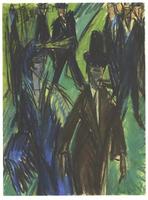
Street Scene
Ernst Ludwig Kirchner
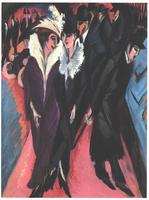
Street, Berlin
Ernst Ludwig Kirchner
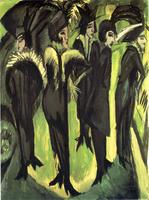
Five Women in the Street
Ernst Ludwig Kirchner
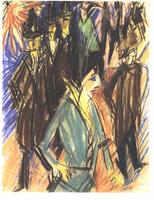
Street Scene with Green Cocotte
Ernst Ludwig Kirchner
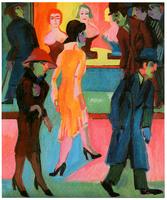
Street Scene in front of a Barbershop
Ernst Ludwig Kirchner
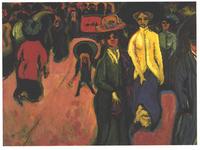
Street, Dresden
Ernst Ludwig Kirchner
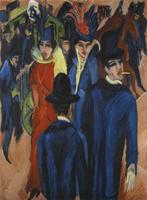
Berlin Street Scene
Ernst Ludwig Kirchner
Scheiber Hugó, Nagyvárosi Életkép,
Scheiber Hugó
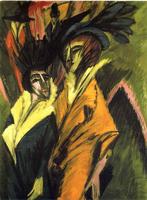
Two Women at the Street
Ernst Ludwig Kirchner
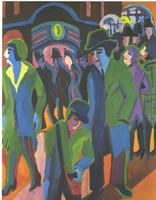
Street with Passangers
Ernst Ludwig Kirchner
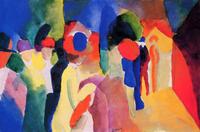
Woman with a Yellow Jacket
August Macke
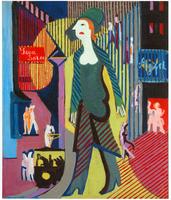
Woman is Walking over a Nighty Street
Ernst Ludwig Kirchner
Farewell
August Macke
Potsdamerplatz
Ernst Ludwig Kirchner
Fashion Store
August Macke
Bal Bullier
William James Glackens
La Goulue and Paul Lescau
Henri de Toulouse-Lautrec
Theatre Scene (Ida Aalberg as Maria Stuart)
Magnus Enckell