Analyse experte de Railway in Dresden de Ernst Ludwig Kirchner
Style : Expressionism · Genre : landscape
Expert Analysis: “Railway in Dresden” by Ernst Ludwig Kirchner
As a defining work of German Expressionism, “Railway in Dresden” embodies the movement’s core aim: to convey emotional experience over objective representation. Kirchner, a founding member of the avant-garde group Die Brücke, transforms a mundane urban landscape into a raw, psychologically charged scene.
Significance within Expressionism
The painting’s importance lies in its vivid, non-naturalistic palette and distorted forms—hallmarks of the style. Kirchner uses jarring contrasts (e.g., deep blues against fiery oranges) and aggressive, jagged brushstrokes to evoke the anxiety and dynamism of modern industrial life. The railway, a symbol of progress and alienation, is not rendered with precision but as a looming, almost hostile force, reflecting the Expressionist preoccupation with the individual’s struggle within an increasingly mechanized society.
Composition & Technique
Kirchner flattens perspective, tilting the ground upward and compressing space, a technique borrowed from primitivist and medieval art, amplified by the Brücke group’s rebellion against academic naturalism. The tracks rush diagonally toward the viewer, while the train emits a plume of smoke that merges with the dark sky, creating a sense of claustrophobic energy. This deliberate spatial distortion prioritizes subjective emotion—fear, exhilaration, or urban vertigo—over optical accuracy.
Contextual Legacy
Created in Dresden—then a hub of industrial expansion—the work captures the tension between nature (the sky, the landscape) and technology (the railway). It epitomizes the Expressionist belief that art should externalize inner states, making the invisible visible. Today, “Railway in Dresden” is celebrated as a critical bridge between late Impressionism and the later, more abstract tendencies of Modernism, demonstrating how landscape could be reinvented as a vehicle for psychological and social commentary.
Museum / Gallery
Visuellement similaire
20 œuvres à la composition et à la palette proches
Old harbor area of Amsterdam - drawing by Fons Heijnsbroek - Dutch artist
Fons Heijnsbroek
View of Kościuszko Mound from the Artist's Atelier
Stanisław Wyspiański
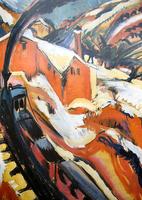
Railways in the Taunus
Ernst Ludwig Kirchner
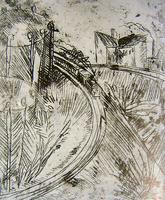
Gasometer in Schöneberg
Ernst Ludwig Kirchner
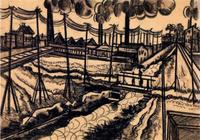
Scheiber Hugó, Városszéle
Scheiber Hugó
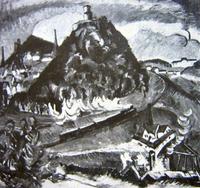
Königstein and railway
Ernst Ludwig Kirchner
Gotwaldov, Czechoslovakia
Fu Baoshi
Platform. The approaching train.
Isaac Levitan
Winter Night
Radi Nedelchev
Scheiber Hugó Külváros, Szén, Pasztell, Papír, 48,5x66,5cm
Scheiber Hugó
Scheiber Hugó, Pályaudvar
Scheiber Hugó
Waterfront
Biruta Baumane
Sand Mine (Igal)
Vilmos Aba-Novak
Scheiber Hugó, Nagyvárosi Fények,.,
Scheiber Hugó
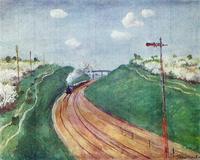
Spring Landscape with train
Pyotr Konchalovsky
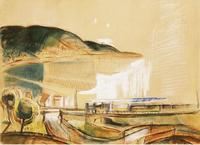
Egry József, Fehér Balaton
Egry József
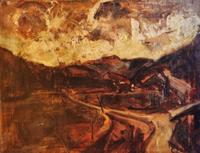
Czóbel Béla Táj Kanyargós Uttal 40.5x50.5
Bela Czobel
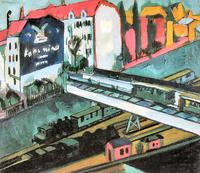
Tram and Rail
Ernst Ludwig Kirchner
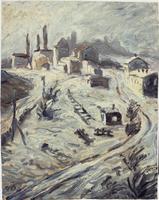
Site With Train Tracks and Houses
Walter Gramatté
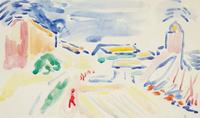
Paysage De Collioure
Henri Matisse