Expert analysis of Ernst Ludwig Kirchner’s Sad Female Head
Style: Cubism · Genre: portrait
Expert Analysis of "Sad Female Head" by Ernst Ludwig Kirchner
Context and Significance
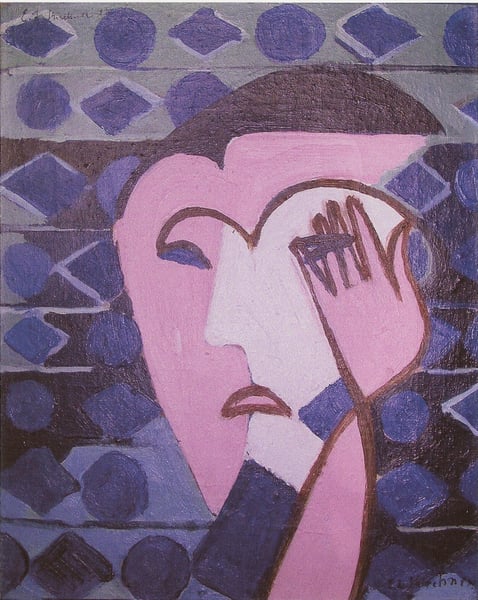
While Ernst Ludwig Kirchner is best known as a founding member of the German Expressionist group Die Brücke, this portrait is distinctly framed within the Cubist style—a departure from his typical expressive, angular woodcut-like forms. The designation reveals a critical moment of cross-pollination: Kirchner absorbed Cubist fragmentation and geometric restructuring (influenced by Picasso and Braque) but channeled it through an emotional, psychologically charged lens. This work thus represents a unique hybrid: the cold, analytical geometry of Cubism merged with the raw, subjective pathos of Expressionism.
Formal Analysis
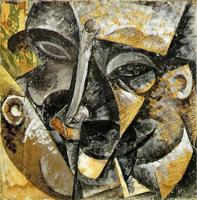
The portrait adheres to Cubist principles—multiple perspectives, faceted planes, and a flattened, shallow space. The head is broken into angular, overlapping shapes, with dislocated features (e.g., an eye shifted off-axis, a nose split into two views). Yet Kirchner subverts Cubism’s typical detachment: the palette—muted grays, ochres, and a stark white—is somber, and the jagged lines create a sense of unease. The title explicitly directs interpretation toward melancholy, a mood enforced by the downward tilt of the face and the heavy, closed or half-lidded eye.
Significance within the Genre
The work redefines the portrait genre by prioritizing inner emotion over external likeness. Unlike Cubist portraits that often treat the sitter as a formal puzzle, Kirchner’s “Sad Female Head” uses Cubist decomposition to externalize internal sorrow. The fragmentation becomes a metaphor for psychological fracture. This synthesis of Cubist structure and Expressionist emotion was groundbreaking in the 1910s–20s, foreshadowing later developments in Neo-Expressionism and figurative abstraction.
Historical Importance
Kirchner’s adoption of Cubism here is not an imitation but a transformation. He retains the style’s intellectual rigor while injecting it with humanity and vulnerability. This work highlights the cross-currents between early 20th-century avant-gardes, showing that even artists outside the core Parisian Cubist circle could repurpose its language for deeply personal, narrative ends. It remains a striking example of how modernism’s formal innovations could serve existential and emotional expression.
Museum / Gallery
Visually similar
20 works with related composition and palette
Girl with Hands
Charles Blackman
This flower wishes to fade
Paul Klee
Woman with cap
Pablo Picasso
La Edad de La Ternura
Oswaldo Guayasamin
Hlava
Josef Capek
Woman turned right
Pablo Picasso
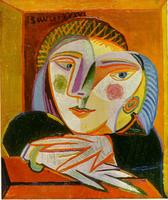
Woman by the window
Pablo Picasso
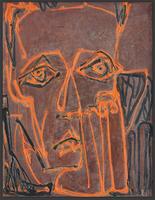
Anguish
Mykhailo Vainshtein
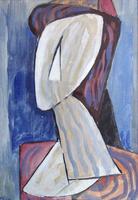
Portrait
Hryhorii Havrylenko
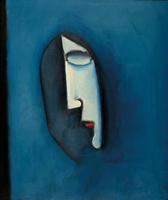
Face
Charles Blackman
Saviour's face: Martyr
Alexej von Jawlensky

Saviour's Face - Christ
Alexej von Jawlensky
Woman with yellow hat (Jacqueline)
Pablo Picasso
study #069
Toshihiko Okuya
Image
Vilen Barsky
Concert
Louis Marcoussis
Face. Altai
Volodymyr Loboda
Pharisees
Karl Schmidt-Rottluff
Portrait of woman
Pablo Picasso
Dynamism of a man's head
Umberto Boccioni