Analisi esperta di Street at Stadtpark di Ernst Ludwig Kirchner
Stile: Expressionism · Genere: cityscape
Expert Analysis: Street at Stadtpark by Ernst Ludwig Kirchner
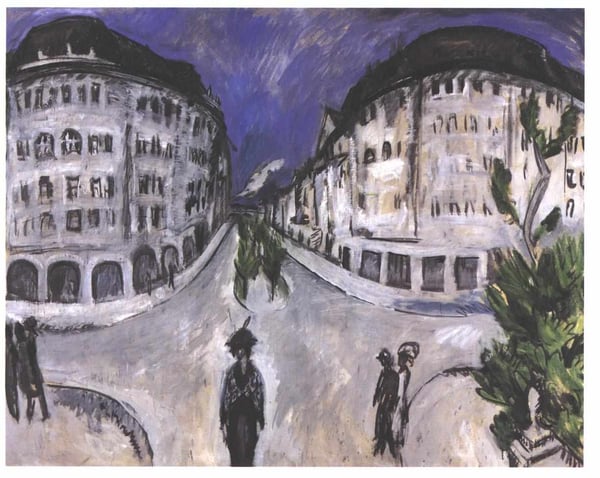
Ernst Ludwig Kirchner’s Street at Stadtpark is a quintessential Expressionist cityscape that captures the raw, nervous energy of early 20th-century urban life. As a founding member of the Brücke group, Kirchner pioneered a style that rejected naturalism in favor of emotional intensity, and this work exemplifies that revolutionary approach.
Significance within Expressionism:
- Distorted perspective and flattened space: The scene is compressed, with buildings and figures pushed unnaturally close to the picture plane, creating a claustrophobic, almost vertiginous sense of speed and anxiety. This lack of depth mirrors the psychological disorientation of modern city dwellers.
- Vivid, unnatural color: Kirchner uses jarring combinations—acid greens, electric blues, and sharp oranges—not to depict reality but to convey a heightened emotional state. The colors seem to vibrate against one another, reflecting the artist’s inner turmoil and the frenetic pace of street life.
- Jagged, gestural brushwork: Rapid, knife-like strokes fragment forms into angular shards. Figures become elongated, mask-like silhouettes, stripped of individuality and reduced to anonymous types—a hallmark of Kirchner’s urban scenes that comments on alienation in the modern metropolis.
- Psychological tension: Unlike impressionist cityscapes that celebrate leisure, Kirchner’s city is a place of unease. The street is crowded yet isolating; passersby seem disconnected, driven by unseen forces. This tension between motion and stasis, between proximity and emotional distance, defines the Expressionist vision of the city as both thrilling and threatening.
Contextual importance: Painted during Kirchner’s Berlin years (c. 1913–1915), Street at Stadtpark belongs to his iconic series of street scenes that anticipate the anxiety of World War I. It stands as a radical redefinition of the cityscape genre: no longer a picturesque backdrop, but a psychological landscape of modern consciousness. The painting’s deliberate crudeness and raw expressiveness helped establish Expressionism as a powerful tool for critiquing contemporary life, influencing generations of urban artists.
Visivamente simili
20 opere con composizione e palette affini
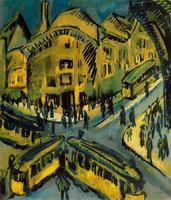
Nollendorfplatz
Ernst Ludwig Kirchner
Czobel Házak
Bela Czobel
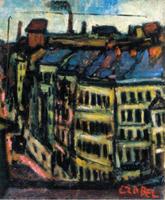
Czobel Házak
Bela Czobel
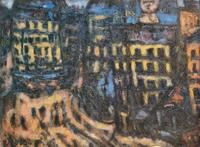
Paris Szent György Square
Bela Czobel
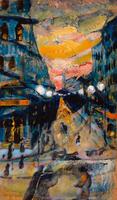
Scheiber Hugó, Nagyvárosi Dinamika 1920
Scheiber Hugó
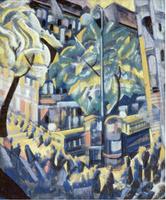
Scheiber Hugó , Város Fénye 1920
Scheiber Hugó
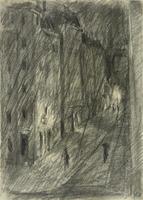
City street in the night
Max Gubler
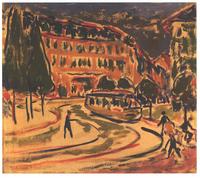
Tramway in Dresden
Ernst Ludwig Kirchner
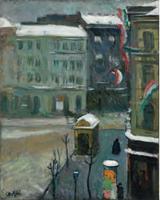
Untitled
Bela Czobel
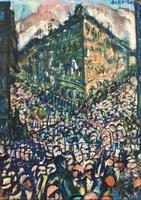
Scheiber Hugó Tömeg, 1919, Olaj, Papírlemez, 69,5x5cm
Scheiber Hugó
Scheiber Hugó, Városi Forgatag
Scheiber Hugó
Scheiber Hugó, Városi Forgatag
Scheiber Hugó
Scheiber Hugó, Klauzál Tér
Scheiber Hugó
Párizsi Utca
Bela Czobel
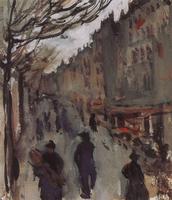
Boulevard in Paris
Zinaida Serebriakova
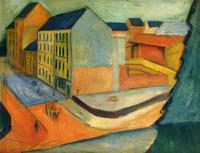
Our street with horse riding, Bonn
August Macke
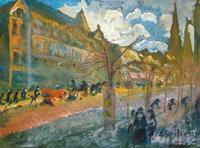
Scheiber Hugó, Esős Város
Scheiber Hugó
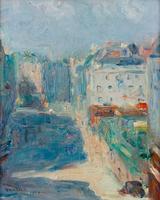
View of the Paris Hotel
Tarsila do Amaral
Milan
Konstantin Korovin
Vichy
Konstantin Korovin