Ernst Ludwig Kirchner sanatçısının Nollendorfplatz eseri hakkında uzman analizi
Tarz: Expressionism · Tür: cityscape
Expert Analysis: "Nollendorfplatz" by Ernst Ludwig Kirchner
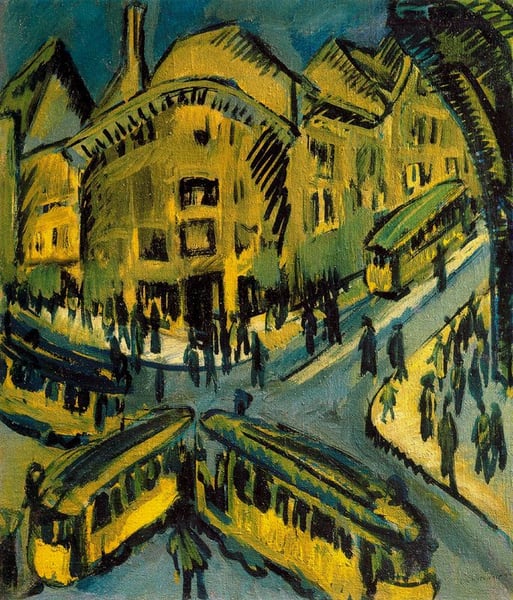
As a pivotal figure in German Expressionism and a founding member of the group Die Brücke (The Bridge), Ernst Ludwig Kirchner transformed the urban landscape into a psychological battlefield. His painting Nollendorfplatz (c. 1912) is a landmark work within the cityscape genre, capturing the frenetic energy and underlying alienation of modern Berlin just before World War I.
Significance within Expressionism
Kirchner’s Nollendorfplatz is significant for its radical departure from naturalistic representation. Instead of a faithful topographical view, the painting is a visceral emotional response to the city. Kirchner employs the hallmarks of Die Brücke style: jagged, angular lines, a clashing palette of acidic greens, screaming yellows, and deep blues, and a deliberate flattening of space. The streetlamp at the center is not a functional object but a spiky, anthropomorphic sentinel; the facades of buildings seem to lean inward, as if the architecture itself is suffocating. This distortion is not a flaw but an expressive tool—it makes the viewer feel the speed, noise, and psychological pressure of the modern metropolis.
Significance as a Cityscape
What makes Nollendorfplatz exceptional within Kirchner’s oeuvre is its specific depiction of the Berlin street as a site of both carnivalesque excitement and existential dread. Unlike earlier, more orderly cityscapes, Kirchner’s composition is deliberately disjointed: figures are reduced to sharp, mask-like faces and hurried silhouettes, their bodies fragmented by bold slashes of black. The streetcar (a motif Kirchner revisited) cuts diagonally through the canvas, forcing the viewer’s eye into a chaotic churn. This technique prefigures the “dynamic” urban visions of the Futurists, yet Kirchner’s emotional temperature is distinct—it is anxious, restless, and deeply subjective.
Legacy
Nollendorfplatz stands as a definitive statement of Kirchner’s belief that art must document not what the eye sees, but what the soul experiences. It is a key work in the transition from a decorative, fauve-inspired Expressionism toward a more psychologically penetrating, even corrosive, style that would influence later modernists. The painting remains a powerful testament to Expressionism’s capacity to turn a city square into a mirror of the modern condition—thrilling, fragmented, and never at rest.
Görsel olarak benzer
İlişkili kompozisyon ve renk paletine sahip 20 eser
Piazza Del Duomo
Carlo Carra
Place de la Republique, Rouen (with Tramway)
Camille Pissarro
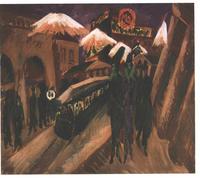
Leipziger Strasse with eletric train
Ernst Ludwig Kirchner
Harlem Street
William H. Johnson
End of the Trolley Line, Oak Park, Illinois
Childe Hassam
Street, Dresden
Ernst Ludwig Kirchner
The Fourteenth of July Celebration in Paris
Vincent van Gogh
Milan
Konstantin Korovin
Night At Piazza Beccaria In Milan
Carlo Carra
Valencia Street with awnings
Joaquín Sorolla
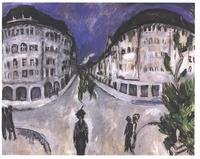
Street at Stadtpark
Ernst Ludwig Kirchner
Street Corner
Robert Henri
Czobel 1925
Bela Czobel
Scheiber HUgó , Esős Utca 1928
Scheiber Hugó
Uscita da un ballo in maschera
Giovanni Boldini
La Place Clichy
Pierre Bonnard
Czobel Házak
Bela Czobel
Czobel Házak
Bela Czobel
View of Riera de Sant Joan from the window
Pablo Picasso
Urban landscape
Mario Sironi