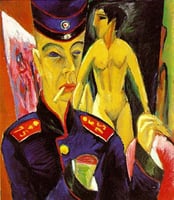
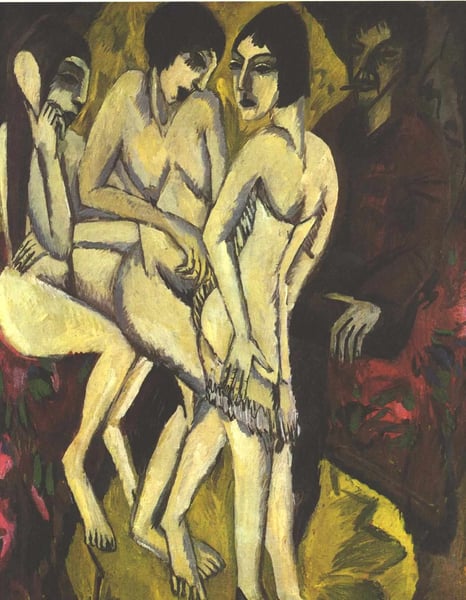
The Choice of Paris
Expert analysis of Ernst Ludwig Kirchner’s The Choice of Paris
Style: Expressionism · Genre: nude painting (nu)
Analysis of "The Choice of Paris" by Ernst Ludwig Kirchner
Ernst Ludwig Kirchner’s The Choice of Paris is a paradigmatic example of early 20th‑century Expressionism, a movement that sought to convey emotional experience over naturalistic representation. Painted in 1912–1913, this work reinterprets the classical mythological subject—the Judgement of Paris—through the lens of modern, urban angst and primal vitality.
Significance within Expressionism
-
Subversion of Classical Ideals
Traditional depictions of Paris awarding the golden apple to Aphrodite were synonymous with idealized beauty and harmonious composition. Kirchner shatters this convention: his figures are angular, elongated, and rendered in jarring, non‑naturalistic colors (sharp greens, electric blues, and acidic yellows). The female nudes are not passive, graceful deities but aggressive, almost tribal presences, reflecting the Expressionist desire to strip away academic polish and reveal raw, instinctual forces. -
Formal Radicalism
Kirchner’s use of distorted perspective and flattened space—influenced by African and Oceanic art as well as German medieval woodcuts—creates a sense of compression and psychological urgency. The figures loom forward, their outlines harsh and broken, mimicking the jagged rhythms of the modern city. This formal vocabulary was central to Die Brücke (The Bridge), the Dresden‑based group Kirchner co‑founded, which aimed to “bridge” the gap between traditional art and a new, expressive language. -
Modern Re‑enactment of Myth
Unlike earlier, serene treatments of the subject (e.g., by Rubens or Renoir), Kirchner’s version is charged with tension. The myth becomes a metaphor for the artist’s own struggle between sensuality, desire, and the dangers of modern urban life. The choice—traditionally one of beauty—appears here as a fraught, almost violent encounter, echoing Expressionism’s fascination with the primal, the erotic, and the alienated self.
Conclusion
The Choice of Paris is significant because it epitomizes how Expressionism transformed a timeless myth into a vehicle for contemporary emotional and formal rebellion. Kirchner’s bold, dissonant palette and fractured, dynamic linework reject classical harmony in favor of immediate, visceral impact—a hallmark of the movement’s revolutionary spirit. This painting stands as a key work in the shift from the decorative to the psychological, marking Kirchner as a pioneer of modern art’s profound re‑examination of representation and meaning.
Visually similar
20 works with related composition and palette
Three Girls in a Wood
Otto Mueller
Nudes and bust
Pablo Picasso
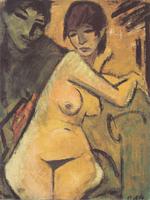
Liebespaar
Otto Mueller
Zwei Am Teichrand Sitzende Mädchenakte
Otto Mueller
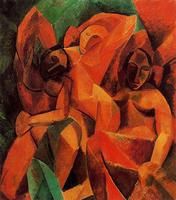
Three women
Pablo Picasso
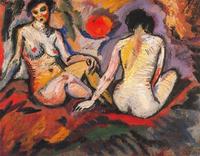
Two seated nudes
Albert Bloch
Nudes
George Stefanescu
Three Nudes in a Forest
Max Weber
Female Nude Kneeling before a Red Screen
Ernst Ludwig Kirchner
Bathing women
Andre Derain
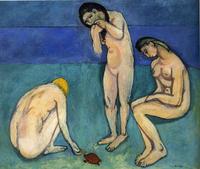
Bathers with a Turtle
Henri Matisse
Untitled (Three Nudes)
Mark Rothko
Junger Mann Und Mädchen
Erich Heckel
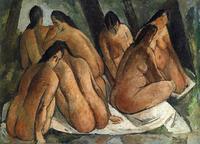
Bathers
Andre Derain
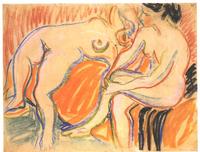
Two Female Nudes
Ernst Ludwig Kirchner
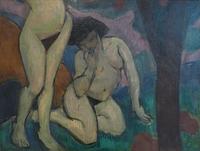
Nudes in landscape
Roger de La Fresnaye
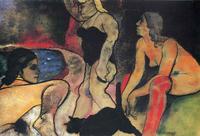
The Rise of Fascism
R. B. Kitaj
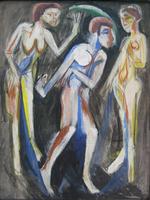
The Dance between the Women
Ernst Ludwig Kirchner
Two Women
Karl Schmidt-Rottluff
Baptism
Marcel Duchamp