Expert analysis of Jacopo Pontormo’s Anatomical study
Style: Mannerism (Late Renaissance) · Genre: sketch and study
Expert Analysis of Jacopo Pontormo's Anatomical Study
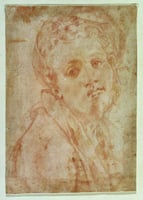
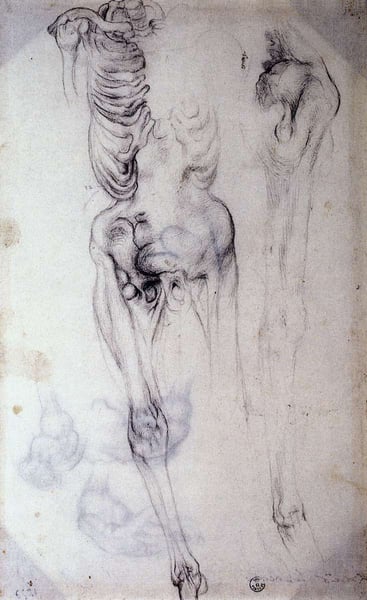
As a work of Mannerism (Late Renaissance) executed in the sketch-and-study genre, Pontormo’s Anatomical Study offers a rare window into the artist’s deeply personal and experimental approach to the human figure. While the structured facts provided are brief, they point to the central significance of this piece within its period and style.
Mannerist Distortion and Expressive Anatomy
Unlike the balanced, idealized anatomy of High Renaissance masters such as Michelangelo or Raphael, Pontormo’s study exemplifies Mannerism’s deliberate departure from classical harmony. The sketch format—likely a preparatory drawing—allows for spontaneous, elongated proportions and exaggerated musculature that prioritize emotional tension over naturalistic accuracy. This distortion is not a failure of skill but a conscious choice to convey inner psychological states, a hallmark of Mannerist art.
The Study as a Revelatory Process
As a sketch and study, this work illuminates Pontormo’s working method. In Mannerism, the preparatory drawing became an independent artistic statement, preserving the raw energy of the artist’s hand. Here, the anatomical focus suggests a rigorous investigation of the body’s mechanics—perhaps for a larger composition—yet the unfinished quality invites the viewer to witness Pontormo’s intellectual and artistic struggle. This emphasis on process over polished finish aligns with the Mannerist fascination with virtuosity and the artist’s unique maniera (style).
Significance in Context
Pontormo’s Anatomical Study is significant because it exemplifies how Mannerism redefined the relationship between art and nature. Rather than replicating anatomy with scientific precision (as in the earlier Renaissance), the artist reshapes the body to serve expressive ends. This work stands as a testament to the period’s shift from objective observation to subjective interpretation—a bridge between High Renaissance order and the more emotive, stylized art of the Baroque. It also underscores Pontormo’s role as a pioneer of Mannerism, whose studies remain vital documents of an era in artistic flux.
Museum / Gallery
Visually similar
20 works with related composition and palette
Drawing of the comparative anatomy of the legs of a man and a dog
Leonardo da Vinci
Skeleton
Vincent van Gogh
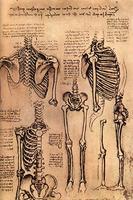
Drawing of the Torso and the Arms
Leonardo da Vinci
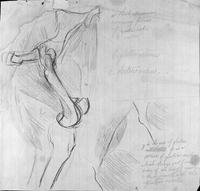
Anatomical drawing
Thomas Eakins
Untitled
Jacques Villon
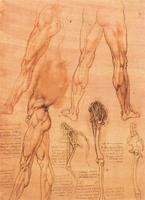
Studies of legs of man and the leg of a horse
Leonardo da Vinci
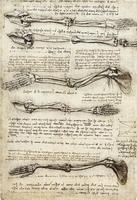
Studies of the Arm showing the Movements made by the Biceps
Leonardo da Vinci
Skeleton on material
Antoni Tapies
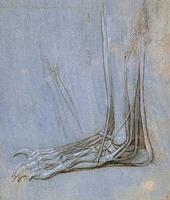
The anatomy of a foot
Leonardo da Vinci
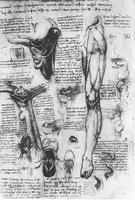
Anatomical studies (larynx and leg)
Leonardo da Vinci
Kondor Béla, a Képzeleted Megtévesztett Engem
Kondor Béla
Untitled
Arturo Rivera
Untitled
Zdzislaw Beksinski
After the Visit
Paul-Albert Besnard
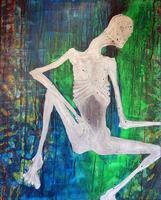
Untitled
Kurt Cobain
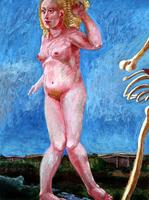
Prehistoric Figure
Charles Garabedian
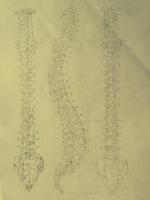
Anatomical Studies
Youssef Idrissi
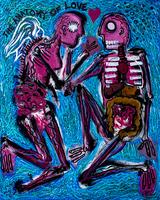
The Anatomy of Love
Mikey William Cheung
Anatomy of the Neck
Leonardo da Vinci
Shoe Shine Boys
Gebre Kristos Desta