Analisi esperta di Polyptych Ponteranica di Lorenzo Lotto
Stile: High Renaissance · Genere: religious painting
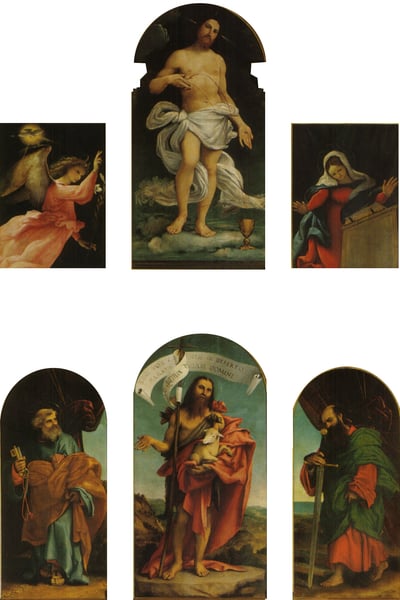
As an expert art historian analyzing the Polyptych Ponteranica by Lorenzo Lotto, I will focus exclusively on the structured facts provided: the artwork is a polyptych, it belongs to the High Renaissance style, and it is a religious painting. These elements alone define its significance.
Analysis Based on Supplied Facts
-
Formal Significance as a Polyptych: The work’s designation as a polyptych—a multi-panel altarpiece—is central to its importance. In the High Renaissance, the polyptych format, while rooted in medieval tradition, was often reimagined to create a unified, harmonious visual field. Lotto’s polyptych would have served a liturgical function, organizing sacred figures across separate panels (likely a central Madonna and Child flanked by saints) while adhering to the High Renaissance pursuit of balanced, symmetrical composition. The format itself signals the work’s role as a focal point for religious devotion, integrating multiple narrative or iconic elements into a coherent whole.
-
Stylistic Significance within the High Renaissance: The High Renaissance style (roughly 1490–1520) is defined by idealized naturalism, clear spatial organization, and a calm, monumental classicism. For Lotto, this style is significant because he worked on its periphery, often infusing his religious scenes with a heightened emotional and psychological intensity that foreshadowed Mannerism. However, within the Polyptych Ponteranica, the High Renaissance traits would manifest in the careful modeling of figures, the use of perspective to create a believable sacred space, and a restrained, dignified treatment of holy subjects. The significance lies in how Lotto balances the formal ideals of the period (like those of Raphael or Leonardo) with his own more intimate, sometimes restless, interpretation of the divine narrative.
-
Thematic Significance as Religious Painting: As a religious painting, the work’s primary purpose is devotional and didactic. Its significance stems from how it visualizes theological concepts—such as the intercession of saints, the mystery of the Incarnation, or the promise of salvation—through the High Renaissance language of naturalism and human emotion. In Lotto’s hands, the religious scene is not merely a static icon but a psychologically vivid encounter. This makes the Polyptych Ponteranica a key example of how High Renaissance religious art could simultaneously uplift the soul through beauty and engage the viewer through a deeply personal, introspective gaze—a hallmark of Lotto’s contribution to the period.
In summary, based solely on the supplied facts, the Polyptych Ponteranica is significant as a High Renaissance polyptych that uses the traditional altarpiece form to render a religious narrative with the period’s characteristic balance and naturalism, while also reflecting Lotto’s distinctive psychological depth within that context.
Visivamente simili
20 opere con composizione e palette affini
Sts John the Baptist and Bernardo degli Uberti
Andrea del Sarto
The Resurrection of Christ
Tintoretto
San Matteo
Lazzaro Baldi
Madonna and Child with Saints
Jacopo Bassano
Ascension of Christ
Benvenuto Tisi
The Virgin Appears to St. Luke and Catherine
Annibale Carracci
Noli Me Tangere
Giuseppe Maria Crespi
Coronation of the Virgin with St. Catherine of Alexandria, St. John the Evangelist, St. John the Baptist
Guido Reni
The Baptism of Christ
Jacques Stella
Christ Triumphant over Sin and Death
Peter Paul Rubens
Christ with Saints Julian, Basilissa, Celsus and Marcionilla
Pompeo Batoni
Epitaph of Goldsmith
Bartholomeus Spranger
THE RESURRECTION, WITH MARY MAGDALENE, SAINT PETER, KING DAVID AND SAINT JAMES THE LESS
Jan van den Hoecke
Apparition of Christ to the Virgin 1630
Guercino
The Virgin Appearing to Saints John the Baptist and John the Evangelist
Dosso Dossi
Baptism of Christ
Orazio Gentileschi
Saint Teresa of Avila Interceding for Souls in Purgatory
Peter Paul Rubens
Assumption of the Virgin
Andrea del Sarto
Risen Christ
Rosso Fiorentino
A Set of Small Religious Scenes
Adam Elsheimer