
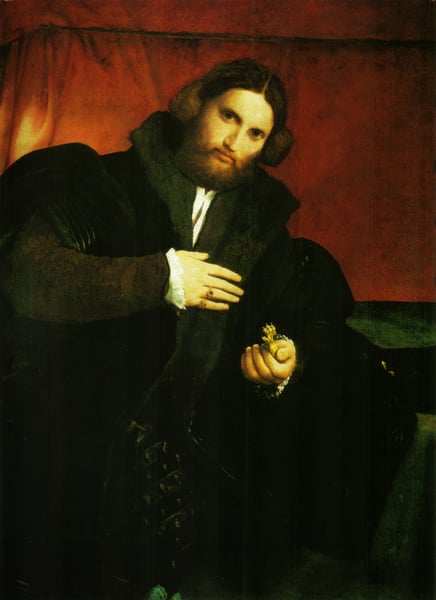
Portrait of a gentleman with lion paw
Details
Expert analysis of Lorenzo Lotto’s Portrait of a gentleman with lion paw
Style: High Renaissance · Genre: portrait
Expert Analysis: Portrait of a Gentleman with Lion Paw by Lorenzo Lotto (High Renaissance)
Lorenzo Lotto’s Portrait of a Gentleman with Lion Paw stands as a compelling, if lesser‑known, example of High Renaissance portraiture—a genre that reached its peak in the works of Leonardo, Raphael, and Titian. Yet Lotto’s approach is distinctively un‑idealized and psychologically penetrating, marking him as an outlier within the period’s dominant harmonies.
Composition and Symbolism
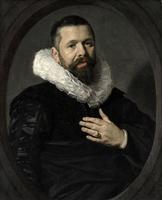
The painting depicts a gentleman whose identity remains uncertain, but the inclusion of a lion’s paw—often interpreted as an emblem of strength, nobility, or a personal heraldic device—imbues the portrait with allegorical weight. In High Renaissance tradition, accessories were rarely arbitrary; they encoded the sitter’s status, virtues, or aspirations. Here, the paw may allude to courage, dominion, or membership in a chivalric order. Lotto’s treatment of this motif is tactile and almost confrontational, drawing the eye to the sitter’s hand resting on the paw, merging human agency with animal power.
Style and Psychological Depth
Unlike the serene, generalized beauty of Raphael’s portraits or the luminous grandeur of Titian’s, Lotto’s work is marked by nervous energy and introspective unease. The gentleman’s face is rendered with meticulous realism—every wrinkle, shadow, and slight asymmetry preserved—suggesting a specific personality rather than an ideal type. Lotto’s handling of light and color, though rooted in Venetian tradition, is more restless: the dark background isolates the figure, while the crisp contours of the fur and the glint of metal (perhaps a ring or hilt) create a subtle tension. This psychological depth aligns Lotto with a more individualistic strain of the High Renaissance, one that anticipates the Mannerist focus on complexity and ambiguity.
Historical Significance
Within the High Renaissance, Lotto’s portraiture offers a counter‑narrative to the era’s prevailing classicism. While Titian and others catered to princely courts with flattering, monumental imagery, Lotto often worked for provincial patrons and clerics, resulting in works that are more intimate and emotionally charged. Portrait of a Gentleman with Lion Paw exemplifies his ability to invest a seemingly conventional portrait with symbolic enigma and quiet drama. It reminds us that the High Renaissance was not a monolithic style but a field of diverse voices, with Lotto representing a path of personal expression over idealization—a path that would deeply influence later Baroque portraiture’s emphasis on character and narrative.
Museum / Gallery
Visually similar
20 works with related composition and palette
Man with a Golden Paw
Lorenzo Lotto
Portrait of a Man in Black Silk Cloak
Lorenzo Lotto

Portrait of Johannes Wtenbogaert
Rembrandt

Portrait of Gerolamo Mercuriale
Lavinia Fontana
Portrait of a Man, Said to Be Christopher Columbus
Sebastiano del Piombo

Quirinus Stercke
Ferdinand Bol
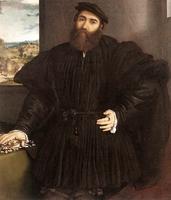
Portrait of a Gentleman
Lorenzo Lotto
Portrait of a man
Karel Van Mander
Unknown gentleman with music books and lute
Hans Holbein the Younger
Portrait of a gentleman wearing a beret
Parmigianino
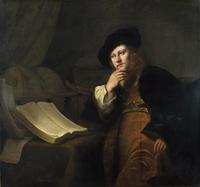
An Astronomer
Ferdinand Bol
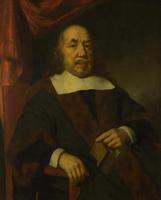
Portrait of an Elderly Man in a Black Robe
Nicolaes Maes

Porträt Eines Mannes
Sebastiano del Piombo
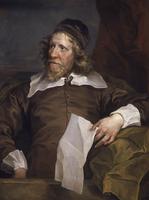
Inigo Jones
William Hogarth
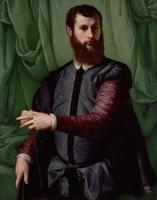
Portrait of a Man
Francesco de' Rossi (Francesco Salviati), "Cecchino"
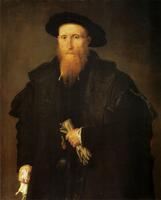
Portrait of a gentleman with gloves
Lorenzo Lotto
Portrait of Jacopo Foscarini
Giovanni Battista Moroni
Portrait of Reinerus Frisius Gemma
Maerten van Heemskerck
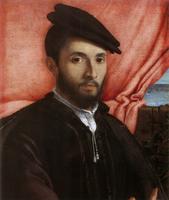
Portrait of a young man
Lorenzo Lotto
Portrait of a Bearded Man with a Ruff
Frans Hals