
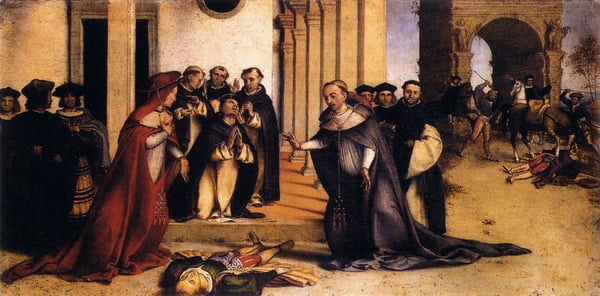
Expertenanalyse zu Lorenzo Lottos St. Dominic Raises Napoleone Orsini
Stil: High Renaissance · Genre: religious painting
Expert Analysis: St. Dominic Raises Napoleone Orsini by Lorenzo Lotto (High Renaissance)
Lorenzo Lotto’s St. Dominic Raises Napoleone Orsini occupies a distinctive place within the High Renaissance tradition, a period typically defined by idealized harmony, balanced composition, and classical restraint. Yet Lotto’s contribution to this style is marked by an intense psychological realism and a deeply personal narrative approach that sets his religious works apart from the more monumental, serene achievements of contemporaries like Raphael or Leonardo.
Significance within the High Renaissance style:
-
Emotional immediacy in a sacred subject – While High Renaissance religious paintings often emphasize divine order and timeless grace, Lotto infuses the miracle scene with a palpable human tension. The moment of resurrection (St. Dominic raising the young Napoleone Orsini) is rendered not as a static, perfect tableau but as a charged, almost intimate encounter. This emphasis on individual emotional response—the awe, anxiety, or faith of the witnesses—reflects Lotto’s departure from the idealized uniformity typical of the style, instead anticipating the more expressive concerns of the later Mannerist period.
-
Vibrant, idiosyncratic color and light – Lotto was a master of Venetian colorism, but his palette often veers toward the unexpected and the psychologically suggestive. In this work, the vivid hues and dramatic chiaroscuro serve to heighten the miraculous nature of the event, drawing the viewer’s eye to the central action. This use of color diverges from the more balanced, naturalistic tones of his High Renaissance peers, making the painting feel both spiritually urgent and personally introspective.
-
Narrative detail and characterization – High Renaissance religious paintings frequently subordinate narrative realism to formal grandeur. Lotto, however, prioritizes the story itself: each figure, from St. Dominic to the onlookers, exhibits a distinct facial expression and gesture that communicate a specific psychological state. This attention to individualized characterization—rather than generic types—underscores Lotto’s reputation as a painter of the soul, a quality that makes St. Dominic Raises Napoleone Orsini a significant example of High Renaissance art that looks forward to the complex interiority of later centuries.
Conclusion: Lorenzo Lotto’s work is significant precisely because it pushes the boundaries of the High Renaissance style from within. Where other masters sought timeless perfection, Lotto sought human truth. St. Dominic Raises Napoleone Orsini is thus not only a masterful religious narrative but also a pivotal document of the stylistic tensions that would eventually reshape Renaissance painting into the more expressive, dynamic forms of Mannerism and the Baroque.
Museum / Gallery
Visuell ähnlich
20 Werke mit ähnlicher Komposition und Farbpalette
Saint Nicholas of Tolentino Reviving a Child
Benvenuto Tisi
Life of Saint Dominic
Geertgen tot Sint Jans
Adoration of the Magi: Whole Triptych
Hans Memling

Preaches of Saint Ambrosius
Bernard Van Orley
Menino Jesus entre os Doutores
Cristovao de Figueiredo

The Marriage at Cana
Gerard David
Wings of a Triptych
Hans Memling
Miracle of the Eucharist
Il Sassetta (Stefano di Giovanni)
Jesus in front of Pontius Pilate
Jan Joest
St. Ladislas Presents Wladislav II and His Sons to the Virgin
Bernhard Strigel
Bênção de Santa Auta em Lisboa
Cristovao de Figueiredo
S. Vicente panels
Nuno Gonçalves
The Annunciation
Rogier van der Weyden
Justice of the Emperor Otto: The Ordeal by Fire
Dirk Bouts
Preaching in the Church
Lucas van Leyden
The Adoration of the Magi
Raphael

Adoration of the Magi: Right wing of triptych, depicting the Presentation in the Temple, c.1470-72 (oil on panel)
Hans Memling
St. Dominic Reuscitates Napoleone Orsini
Benozzo Gozzoli
Polyptych of San Vincenzo Ferreri
Giovanni Bellini
Eucharist Altarpiece (detail)
Justus van Gent