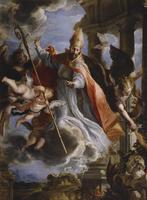
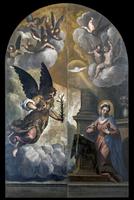
Expert Analysis of Lorenzo Lotto’s St. Nicholas in Glory with St. John the Baptist, St. Lucy and below St. George Slaying the Dragon
As a High Renaissance religious painting, Lorenzo Lotto’s altarpiece is significant for its masterful synthesis of traditional iconography with the artist’s distinctive psychological realism and chromatic originality. While many High Renaissance artists—Raphael, Leonardo, Michelangelo—pursued idealized harmony, Lotto often infused his sacred scenes with intimate human tension and unconventional compositional choices.
Here, the arrangement of figures in two registers (saints in glory above, St. George battling the dragon below) creates a dynamic vertical narrative that bridges heaven and earth. The celestial grouping of St. Nicholas, St. John the Baptist, and St. Lucy demonstrates Lotto’s skill at aligning divine hierarchy with naturalistic gesture: John’s pointing gesture, Lucy’s offering of her eyes, and Nicholas’s blessing all convey distinct spiritual roles while maintaining a cohesive, lyrical group. Below, the dramatic action of St. George—a favorite chivalric subject—provides a vivid contrast, showcasing Lotto’s ability to render movement and tension through bold chiaroscuro and rich, Venetian-tinged color.
The work is also notable for its intimate, almost eccentric details—such as the subtle emotional expressions of the saints—which anticipate Mannerist sensibilities while still rooted in High Renaissance pictorial order. This makes the painting a crucial example of how Lotto negotiated devotional tradition with personal, psychological depth, standing apart from his more serene contemporaries.