
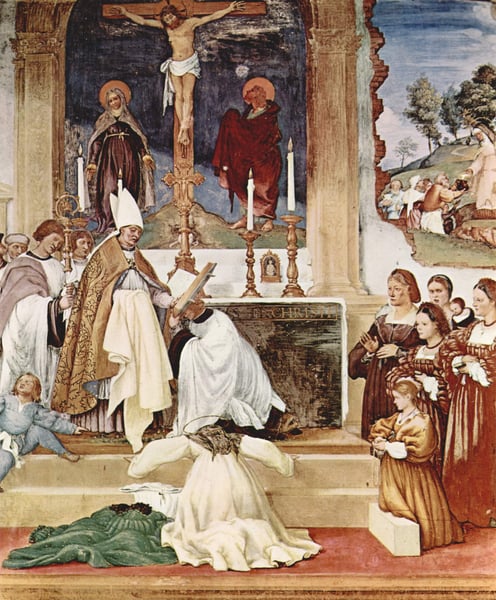
Analisi esperta di The Story of St. Barbara and St. Alvise di Lorenzo Lotto
Stile: High Renaissance · Genere: religious painting
Expert Analysis: "The Story of St. Barbara and St. Alvise" by Lorenzo Lotto
Lorenzo Lotto’s The Story of St. Barbara and St. Alvise stands as a compelling departure from the serene idealism that dominated much of the High Renaissance, showcasing instead the artist’s signature psychological intensity and narrative complexity. Painted during a period when Venetian and Roman masters—Titian, Raphael, Michelangelo—celebrated harmonious balance, Lotto favored a more intimate, emotionally charged approach that often placed his patrons and local saints in unconventional, almost conversational compositions.
Significance within the High Renaissance
While the High Renaissance is typically defined by symmetrical grandeur and classical restraint (think Raphael’s School of Athens or Leonardo’s Last Supper), Lotto represents a vital counter-current. This work merges two distinct saintly narratives—St. Barbara, the patroness of sudden death and artillery, and St. Alvise (St. Louis of Toulouse), a Franciscan bishop—into a single, layered scene. Rather than depicting them in isolated devotional portraits or static altarpieces, Lotto likely weaves their stories into a dynamic, almost theatrical setting that invites the viewer to contemplate their interconnected virtues: faith under persecution (Barbara) and humble renunciation of power (Alvise). This storytelling choice reflects Lotto’s interest in the human condition over mere iconography.
Stylistic Hallmarks
Lotto’s palette, as seen in works like this, is characteristically vivid and idiosyncratic—often employing sharp pinks, greens, and golds that vibrate against each other. The figures are rendered with a probing individuality: St. Barbara may show a nervous, introspective gaze, while St. Alvise’s episcopal robes are treated with meticulous attention to texture, yet his expression carries a subtle melancholy. This psychological realism was rare among Lotto’s peers, who often subordinated individual character to idealized form.
Art-Historical Importance
Lotto’s output (especially his later religious works) anticipates Mannerism and even Baroque sensitivity, but without losing the High Renaissance commitment to spatial coherence and naturalistic anatomy. The Story of St. Barbara and St. Alvise exemplifies his ability to blend sacred narrative with earthly emotion—a quality that has led modern scholars to see him as a deeply personal and proto-modern voice in a period otherwise defined by monumental abstraction.
In essence, this work is significant not because it conforms to the High Renaissance ideal, but because it challenges it: it proves that the era’s religious painting could be intimate, restless, and profoundly human.
Visivamente simili
20 opere con composizione e palette affini
Gregory IX Approving the Decretals
Raphael
The ordination of St. Lawrence
Fra Angelico
Death and Ascension of St. Francis
Giotto
Perugia Altarpiece (left panel)
Fra Angelico
Last Communion of St Jerome
Sandro Botticelli
St. Didacus in Prayer
Maarten de Vos
The Death of St. Francis
Domenico Ghirlandaio
The communion of St. Teresa
Juan Martín Cabezalero
St. Thomas in Glory between St. Mark and St. Louis of Toulouse
Vittore Carpaccio
Madonna of Mercy
Domenico Ghirlandaio
Submission of Frederick Barbarossa before Pope Alexander III during the signing of the Treaty of Venice (detail)
Francesco de' Rossi (Francesco Salviati), "Cecchino"
Pasquale Cicogna Hearing Mass Celebrated in the Oratory of the Crociferi
Palma il Giovane
Confirmation of the Rule
Giotto

Holy Virgin in Glory
Robert Campin
St. Jerome Checking the Stigmata on the Body of St. Francis
Giotto
Presentation in the Temple
Vittore Carpaccio
Katharinenaltar: Die hll. Ulrich und Conrad
Hans Holbein the Elder
Dream of Innocent III and the Confirmation of the Rule (detail)
Benozzo Gozzoli
The Apotheosis of Saint Thomas Aquinas
Francisco de Zurbaran
The purification of the Virgin
Guido Reni