
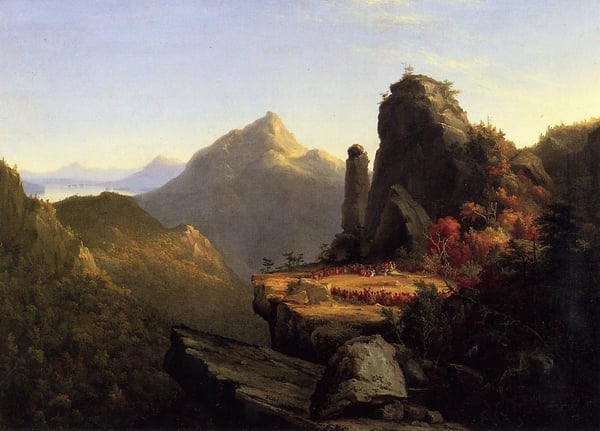
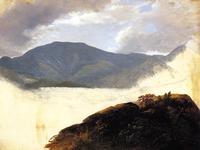
Scene from The Last of the Mohicans Cora Kneeling at the Feet of Tanemund
Details
Expert analysis of Thomas Cole’s Scene from The Last of the Mohicans Cora Kneeling at the Feet of Tanemund
Style: Romanticism · Genre: landscape
Expert Analysis: "Scene from The Last of the Mohicans: Cora Kneeling at the Feet of Tanemund" by Thomas Cole
Thomas Cole’s Scene from The Last of the Mohicans: Cora Kneeling at the Feet of Tanemund (1827) is a landmark work within American Romanticism, merging the conventions of landscape painting with a narrative drawn from James Fenimore Cooper’s 1826 novel. As a founding figure of the Hudson River School, Cole here elevates the natural environment from mere backdrop to an active participant in the drama—a hallmark of the Romantic sublime.
Significance within Romanticism
The painting exemplifies the Romantic obsession with the sublime—a combination of awe, terror, and beauty provoked by untamed nature. Cole frames the human figures within a vast, wild landscape: towering cliffs, gnarled trees, and a dramatic sky. The composition forces the viewer’s eye from Cora’s supplicating pose upward to the towering figure of Tanemund, and then outward to the forested wilderness. This verticality reinforces the power imbalance of the scene while also suggesting that nature itself is the ultimate authority, dwarfing both colonizer and Indigenous leader.
Significance as a Landscape
Though the work contains a specific literary episode, its genre is unequivocally landscape. Cole uses the setting to comment on the transience of human power and the fading “noble savage” ideal. The deep, shadowed foreground contrasts with a luminous distance, a technique Cole borrowed from European masters but adapted to American topography. The painting is also notable for its historical and cultural layering: it reflects contemporary Romantic curiosity about Indigenous cultures (Tanemund appears as a dignified, statuesque figure) while simultaneously portraying their imminent displacement—a theme Cooper’s novel made explicit. Cole’s landscape thus becomes a metaphor for the vanishing frontier, a core anxiety of early 19th-century America.
Artistic Legacy
This work marks an early synthesis of two pillars of American Romanticism: the literary imagination and the celebration of wild nature. By embedding a specific, emotional narrative within a meticulously observed landscape, Cole broke from purely topographical painting and set the stage for later Hudson River School artists to treat nature as a vehicle for moral and spiritual reflection. The painting remains significant for its ability to merge the epic scope of the American wilderness with the intimate, human-scale tragedy of the novel—a union that defines the Romantic ethos.
Museum / Gallery
Visually similar
20 works with related composition and palette
Scene from 'The Last of the Mohicans', by James Fenimore Cooper
Thomas Cole
Indian Sacrifice
Thomas Cole
Mountain Sunrise
Thomas Cole
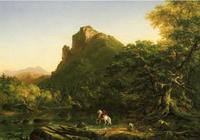
The Mountain Ford
Thomas Cole
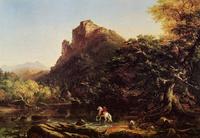
The Mountain Ford
Thomas Cole
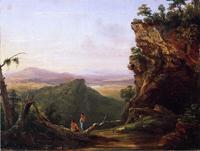
Indians Viewing Landscape
Thomas Cole
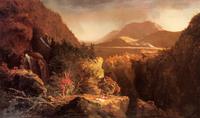
Landscape with Figures A Scene from The Last of the Mohicans
Thomas Cole
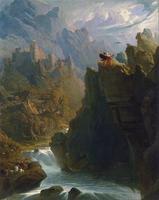
The Bard
John Martin
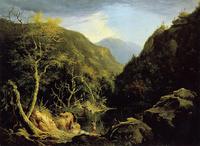
Autumn in the Catskills
Thomas Cole
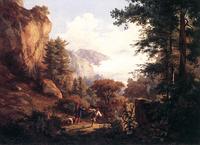
Wanderer and his Guard
Károly Markó the Elder
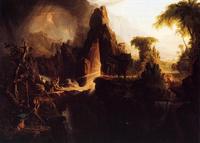
Expulsion from the Garden of Eden
Thomas Cole
Landscape with the Conversion of Saint Paul
Tobias Verhaecht
Alpine Landscape Humans on Mountain Path
Knud Baade
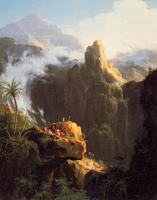
Landscape Composition. St John in the Wilderness
Thomas Cole
Bjerglandskab Med En Flod
Claude-Joseph Vernet
Study of the summits of northern Italy
Oswald Achenbach
Berger et son troupeau dans un paysage de montagne
Johann Heinrich Roos
Southern Mountain Landscape
Adam Pynacker
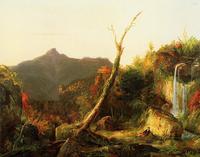
Autumn Landscape (Mount Chocorua)
Thomas Cole
Hudson River Sketch
Asher Brown Durand