
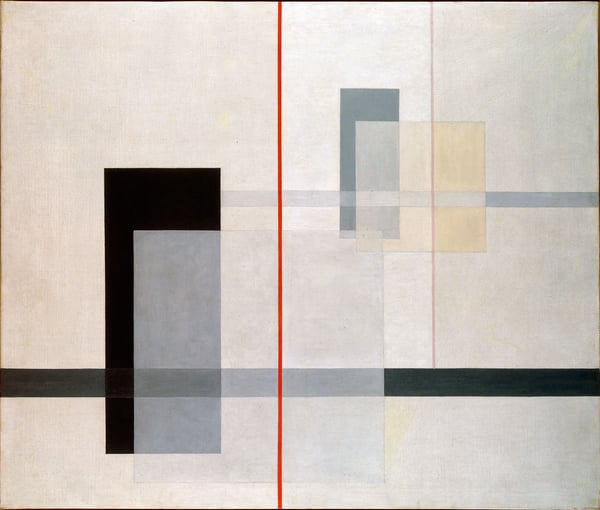
Analisi esperta di K VII di Laszlo Moholy-Nagy
Stile: Constructivism · Genere: abstract
"K VII" (likely part of Moholy-Nagy's Konstruktionen series, circa 1922–23) stands as a quintessential embodiment of Constructivist principles filtered through the artist’s unique synthesis of technology, light, and spatial dynamism. In this abstract composition, Moholy-Nagy moves beyond static geometric arrangement to create what he termed "vision in motion"—a visual experience that suggests the interplay of transparency, overlapping planes, and directional forces.
What makes K VII significant within Constructivism is how it simultaneously adheres to and expands the movement’s core tenets. The work employs a rigorous vocabulary of circles, rectangles, and intersecting lines, yet it refuses pure flatness. Through subtle gradations of tone and the use of translucent or overlapping forms (often achieved in his works via collaged industrial materials or painted illusion), Moholy-Nagy introduces a sense of weightlessness and spatial depth—a direct response to the machine age and its materials. This reflects his belief that art should engage with modern perception, abolishing the static canvas in favor of an activated, kinetic relationship between form and viewer.
Moreover, K VII exemplifies Moholy-Nagy’s lifelong investigation into light as a plastic medium. Even in a painting or collage, he treats color and value as carriers of luminosity, pushing Constructivism beyond pure functionalism into a lyrical, almost photogenic register. This anticipates his later experiments with photograms and light modulators. In the context of the Bauhaus (where he taught from 1923), K VII serves as a bridge between early Russian Constructivism’s social-utopian aims and a more phenomenological, sensory exploration of space—a legacy that would profoundly influence op art, kinetic art, and modernist design.
Visivamente simili
20 opere con composizione e palette affini
June 1937 (painting)
Ben Nicholson
Second Theme
Burgoyne Diller
Composition XXII
Theo van Doesburg
Early Geometric #492
Burgoyne Diller
Grey Pilgrim
Kenneth Noland
Simultaneous Composition XXIV
Theo van Doesburg
White Square
Al Held
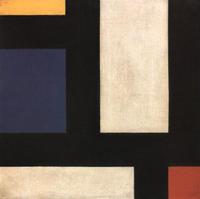
Counter Composition IV
Theo van Doesburg
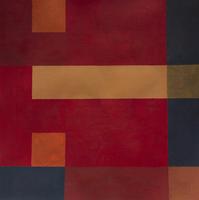
EC20-E1
Thiago Boecan
Contra-Composition VII
Theo van Doesburg
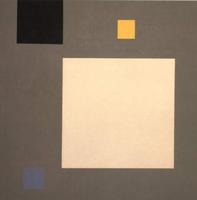
First Theme #4
Burgoyne Diller
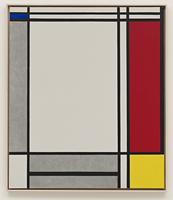
Non Objective I
Roy Lichtenstein
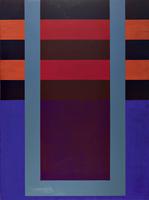
Untitled
Antonio Palolo
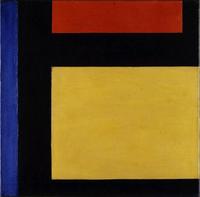
Counter composition X
Theo van Doesburg
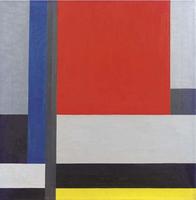
Composition néo-plastique 5a
Cesar Domela
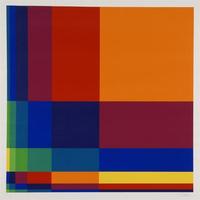
Sechs vertikale systematische Farbreihen mit orangem Quadrat rechts oben
Richard Paul Lohse
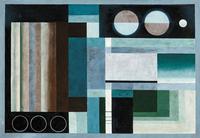
Bortnyik Sándor, Geometrikus Kompozicio
Sandor Bortnyik
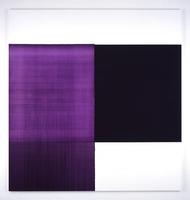
Exposed Painting Dioxazine Violet
Callum Innes
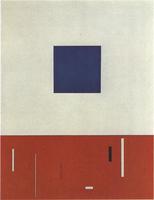
Composition No. 211
Friedrich Vordemberge-Gildewart
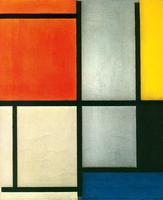
Tableau 3 with Orange -Red, Yellow, Black, Blue and Gray
Piet Mondrian