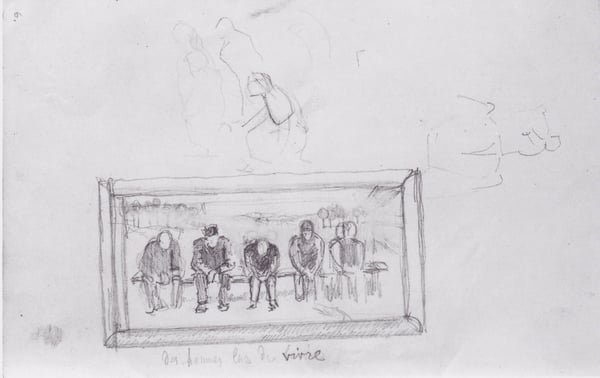
Overall study of the life of weary
Dettagli
Analisi esperta di Overall study of the life of weary di Ferdinand Hodler
Stile: Symbolism · Genere: sketch and study
Analysis of "Overall study of the life of weary" by Ferdinand Hodler
Significance within Symbolism and Hodler’s Oeuvre
Ferdinand Hodler’s Overall study of the life of weary (a preparatory drawing or sketch for his renowned painting Die Lebensmüden / The Life-Weary, c. 1892) is a quintessential Symbolist work that crystallizes the movement’s preoccupation with existential melancholy, the finite nature of life, and the emotional resonance of form. As a sketch and study, this artwork reveals the artist’s rigorous compositional process—a vital aspect of understanding how Symbolist ideas were translated from concept to finished canvas.
Stylistic and Thematic Focus
In Symbolism, the figure is not merely a physical presence but a vessel for abstract states—weariness, resignation, solitude. Hodler’s study strips away color and ornament, leaving only line, tone, and gesture to convey meaning. The slumped postures, the rhythmic repetition of figures (often a hallmark of Hodler’s “parallelism”), and the stark, unadorned setting evoke a collective fatigue—a meditation on the human condition as both universal and deeply personal. The lack of specific narrative or setting pushes the viewer toward introspection, a key Symbolist aim.
Art Historical Importance
This study is significant because it documents Hodler’s transition from naturalistic observation to a more stylized, symbolic language. It exemplifies his use of line as an emotional force—the drooping shoulders, the heavy downward curves of the arms, and the spacing of bodies generate a visual “rhythm of exhaustion.” As a work on paper, it also offers insight into the artist’s hand: the quick, searching strokes and adjustments highlight the immediacy of his response to a theme that haunted late-19th-century European art. In the broader Symbolist canon, Hodler’s Life-Weary studies stand alongside Edvard Munch’s The Sick Child or Odilon Redon’s graphite visions as demonstrations of how drawing can distill profound existential weight with economy and precision.
Conclusion
Overall study of the life of weary is not merely a preparatory note; it is a finished statement in its own right, embodying Symbolism’s core belief that art should express ideas, not just appearances. Its raw, unfinished quality amplifies the sense of vulnerability and transience—making it a powerful example of how a sketch can achieve the same emotional gravitas as a monumental painting, while revealing the very process of Symbolist thought.
Visivamente simili
20 opere con composizione e palette affini
Cursory sketch of three figures by bonfire
Nicholas Roerich
Quin Sketches from Paris Visit 1987
MAUREEN QUIN
Scheiber Hugó, Öten a Padon 1929
Scheiber Hugó
Carolina
Alberto Giacometti
Study of Three Peasants, One Sitting
Vincent van Gogh
Personnages
Aurel Cojan
Sketch
Yiannis Tsaroychis
Man on a Bench
Vincent van Gogh
Sketch with six figure compositions
Paula Modersohn-Becker
Black Tie Party
Pietro Lazzari
Boceto 1 Papel De Colgadura
Beatriz González
Portrait
Alberto Giacometti
Vissers En Vrouwen Aan De Oever
Hendrick Avercamp
A Montparno study
Theophile Steinlen
Femme Assoupie
Bela Czobel
Czobel Lappang................
Bela Czobel
Female image
Hryhorii Havrylenko
Abraham and three Angels
Marc Chagall
Studies Figure The Enclosure Wall of Saint-Paul Hospital and Others
Vincent van Gogh
Reading Aloud
Ilya Repin