
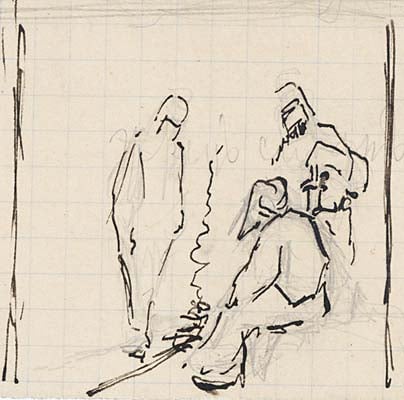
Analisi esperta di Cursory sketch of three figures by bonfire di Nicholas Roerich
Stile: Realism · Genere: sketch and study
Expert Analysis: "Cursory Sketch of Three Figures by Bonfire" by Nicholas Roerich
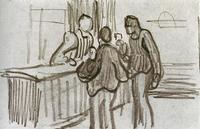
This artwork, a "cursory sketch of three figures by a bonfire," offers a rare glimpse into the foundational process of Nicholas Roerich—an artist whose later fame rests on luminous, spiritually charged canvases. As a work in the Realist style and categorized as a sketch and study, its significance lies not in finished perfection but in its raw, immediate documentation of observation and compositional thinking.
Significance within Roerich’s Oeuvre and the Realist Tradition
-
Evidence of Artistic Process: Unlike Roerich’s more celebrated symbolist and theosophical paintings (e.g., the Himalaya series or The Last of Atlantis), this sketch reveals the bedrock of his training. The "cursory" nature—loose, gestural lines and minimal detail—prioritizes the essential geometry of three figures around a fire. It captures the artist’s spontaneous response to light and movement, a hallmark of Realist sketching where truth to immediate perception outweighs idealization.
-
Focused on Human and Elemental Drama: The bonfire serves as both visual anchor and narrative catalyst. Roerich, deeply interested in the spiritual and the primitive (drawing on ancient Slavic and Asian themes), uses the fire’s glow to unify the three figures. In this study, the Realist treatment of firelight—chiaroscuro effects, warm highlights on faces or garments—foreshadows his later ability to infuse natural light with mystical symbolism. The trio’s poses, likely observed from life, suggest a quiet ritual or gathering, grounding Roerich’s esoteric ideas in tangible human experience.
-
Documentary Value: As a sketch, the work functions as a field note. Roerich traveled extensively through Russia, Central Asia, and the Himalayas, recording landscapes and cultures. This piece—with its compact composition and focus on communal warmth against darkness—belongs to that ethnographic impulse. It shows how Realism served him not as an end, but as a tool for capturing the raw material that would later metamorphose into visionary scenes.
-
Contrast to His Mythic Scope: The name “Cursory Sketch” is itself instructive. It signals humility and craft—the artist as diligent observer, not yet the mystic. This makes the artwork significant as a counterpoint; it proves that Roerich’s later grandeur (populated by wise figures, mountain shrines, and celestial beings) was built on a foundation of precise, earthy observation. The bonfire here is simply fire; figures are simply people. That restraint is the key to understanding how his Realism became the scaffolding for his transcendence.
In sum, this sketch is significant as a document of method—it shows Roerich working in the Realist tradition before his voice expanded into the symbolic, and it preserves a fleeting human moment with economy and sincerity. It is the seed from which his unique blend of naturalism and mysticism grew.
Visivamente simili
20 opere con composizione e palette affini
Overall study of the life of weary
Ferdinand Hodler
Sketch with six figure compositions
Paula Modersohn-Becker
Personnages
Aurel Cojan
Black Tie Party
Pietro Lazzari
Study of compositions and figures
Noè Bordignon
Solo Drawing from the ”Hangers” Performance
Simone Forti
Family Portrait
Salvador Dali
Procopius the Righteous removes a cloud of stone from the Great Ustyug
Nicholas Roerich
Noah and the Rainbow
Marc Chagall
Sketch Book #1
James Taylor Harwood
Sheet with Figures and Hands
Vincent van Gogh
Czobel Lappang................
Bela Czobel
Sketch with the image of a stone woman
Hryhorii Havrylenko
Sketch of the painting Girls on the Volga
Kuzma Petrov-Vodkin
Study on Red Tart
Ernst Ludwig Kirchner
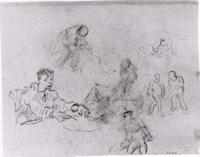
Sheet with Sketches of Peasants
Vincent van Gogh
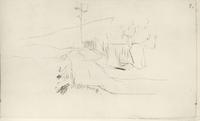
Landscape near Bordiguera
Isaac Levitan
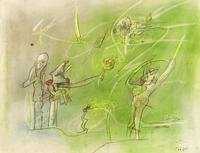
Untitled
Roberto Matta
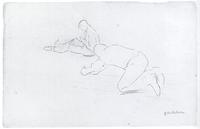
The Floor Scrapers (study)
Gustave Caillebotte
Men in Front of the Counter in a Cafe
Vincent van Gogh