Pastures at the Jonction at Geneva
Dettagli
Analisi esperta di Pastures at the Jonction at Geneva di Ferdinand Hodler
Stile: Realism · Genere: landscape
Expert Analysis of "Pastures at the Jonction at Geneva" by Ferdinand Hodler
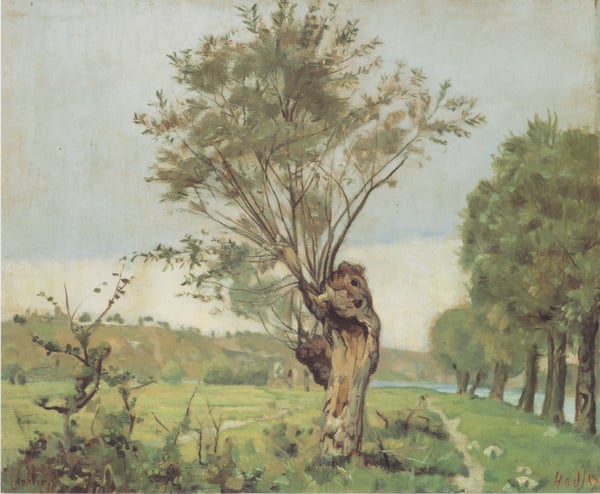
Within the framework of Realism, Ferdinand Hodler’s Pastures at the Jonction at Geneva stands as a quietly radical example of the movement's core ambition: to render the visible world with uncompromising fidelity. While Hodler would later achieve international fame for his symbolist and rhythmic compositions, this landscape belongs to his early, rigorously naturalistic phase. Its significance lies in how it elevates a specific, unglamorous piece of the Swiss countryside—the confluence of the Rhône and Arve rivers—into a subject worthy of serious artistic attention.
Realism’s Democratic Vision True to the Realist creed, Hodler chooses an ordinary, workaday scene: pastures, a modest slope, and the meeting of two rivers. There is no dramatic storm, no heroic figures, no classical ruins. Instead, the artist insists that the inherent structure and light of this mundane locale carry their own visual weight. By treating the Jonction with the same meticulous observation once reserved for history painting, Hodler asserts the dignity of the local and the everyday.
Compositional Clarity and Natural Light The painting's significance is further demonstrated through its disciplined composition. Hodler organizes the scene in clear horizontal bands—foreground pasture, middle-ground riverbank, distant water and sky—creating a stable, almost architectural order. This reflects the Realist preference for clear structure over romantic atmospheric blur. The crisp daylight, likely reminiscent of a specific hour, sculpts the terrain with precise tonal gradations. Shadows are not softened into sentiment; they are recorded as factual patches of darker green and grey. This empirical approach to light and color marks the work as a mature Realist achievement: it captures not just a place, but the exact quality of illumination on that place.
Topographical Authenticity The choice of the Jonction at Geneva—where glacial Arve’s milky waters meet the clear Rhône—is also significant. Hodler does not idealize the site into a generic pastoral. Instead, he presents a recognizable locale, grounding the painting in geographical truth. This topographical specificity is a hallmark of Realism: art as a record of a concrete, named landscape, not an imagined Arcadia.
In summary, Pastures at the Jonction at Geneva is significant as a pure Realist document that honors the ordinary, insists on optical truth, and finds formal coherence in a humble pasture. It reveals Hodler’s early mastery of objective observation—a foundation upon which his later, more symbolic breakthroughs were built.
Visivamente simili
20 opere con composizione e palette affini
Bank of the Loire near Chouze
Paul Trouillebert
Willow on the Banks of the Seine
Gustave Caillebotte
Marshy Pastures
Camille Corot
Pollard Willow At The Side Of The Broo
Cornelis Vreedenburgh
Willows
Theodore Robinson
Landscape at the Jonction at Geneva
Ferdinand Hodler
Feeding the Geese
David Bates
Pond with a Large Tree
Camille Corot
The Old Track to Auvers
Berthe Morisot
Saint Nicholas les Arras, Willows on the Banks of the Scarpe
Camille Corot
Autumn Landscape with Four Trees
Vincent van Gogh
Willow tree by the lake
Ferdinand Hodler
French Girl Minding Sheep
James Charles
Women in a Field of Willows
Camille Corot
Landscape, Banks of the Yerres
Gustave Caillebotte
Recollections of Coubron
Camille Corot
Irrigation Ditch with Mature Willow
Piet Mondrian
Picnic on the Lower Rhine
Hugo Mühlig
Willows and Farmhouses at Saint Catherine les Arras
Camille Corot
Willows at Sunset
Claude Monet