Ferdinand Hodler の Thun, Stockhornkette の専門的な分析
スタイル:Art Nouveau (Modern) · ジャンル:landscape
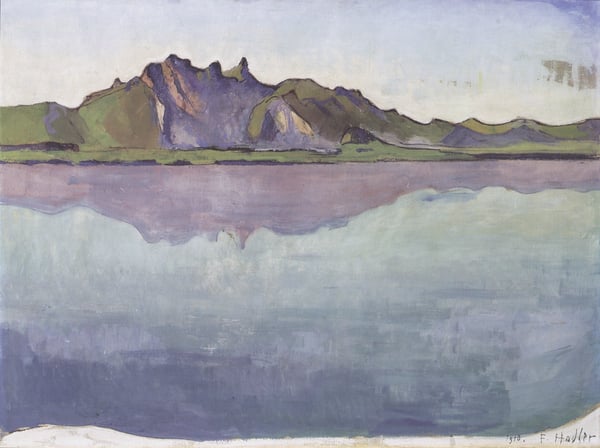
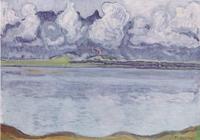
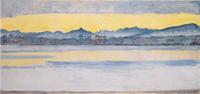
Ferdinand Hodler’s Thun, Stockhornkette is a landmark example of how Art Nouveau (Modern) principles reshaped landscape painting at the turn of the 20th century. Though the subject is a straightforward view of the Stockhorn mountain chain near the town of Thun, Hodler transforms the scene through his signature parallelism—a rhythmic repetition of forms that gives the composition an almost musical, decorative unity.
Significance within Art Nouveau and Modernism:
- Synthesis of nature and abstraction: Hodler distills the alpine panorama into sweeping, parallel bands of color and line. The mountain ridges, clouds, and lake surface are arranged in a near-symmetrical, horizontal rhythm, echoing the organic, flowing curves favored by Art Nouveau artists like Horta or Mucha, but applied to the vast scale of the Swiss landscape.
- Symbolic resonance: Beyond mere topography, Hodler’s landscapes express a universal, pantheistic harmony. The repeated geometric forms of the Stockhornkette create a sense of eternal, ordered beauty—a modern reimagining of nature as a spiritual, structured whole.
- Precursor to abstraction: By emphasizing compositional rhythm over naturalistic detail, Hodler’s work anticipates the formalist concerns of 20th-century modernism. The painting’s bold simplification and flatness (the lake reads as a sheer color field) align with the Art Nouveau impulse to flatten space and prioritize decorative pattern.
Stylistic hallmarks visible in this work:
- Horizontal stratification: The canvas is divided into distinct zones: dark foreground water, middle-ground tree line, bright distant peaks, and sky—each rendered with broad, unmodulated strokes.
- Repetition and symmetry: The diagonal angle of the mountains is echoed in the clouds’ brushed arcs, creating a visual echo that unifies the entire composition.
- Expressive color: Hodler uses vivid, slightly unnatural blues and greens to enhance the scene’s emotional impact, typical of his modern, symbolic palette.
In Thun, Stockhornkette, Hodler elevates a seemingly simple Swiss lake-and-mountain view into a manifesto for Art Nouveau’s core belief: that nature, when subjected to rhythmic, decorative order, reveals a deeper, universal truth. This painting stands as a crucial bridge between 19th-century realism and 20th-century abstraction, demonstrating how landscape could be both modern and profoundly serene.
視覚的に類似
構図やパレットが近い作品 20 件
Thun, Stockhornkette, evening
Ferdinand Hodler
Thun, Stockhornkette
Ferdinand Hodler
Lake Geneva with Mont Blanc in the morning light
Ferdinand Hodler
Near Suez, Red Sea
Marianne North
Lake Geneva with Mont Blanc at dawn
Ferdinand Hodler
Lake Geneva with Mont Blanc in the morning light
Ferdinand Hodler
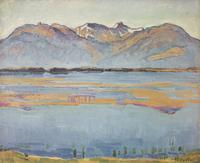
Montanasee
Ferdinand Hodler
Dido's View (from the Site of Carthage)
Violet Oakley
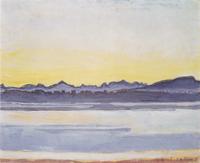
Lake Geneva with Mont Blanc before sunrise
Ferdinand Hodler
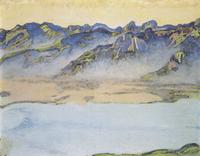
Rising mist over the Savoy Alps
Ferdinand Hodler
Rio-Grande
Nicholas Roerich
Dents du Midi
Ferdinand Hodler
Mirrored Mountain, South Greenland
Rockwell Kent
The Grammont in the morning sun
Ferdinand Hodler
Thun, Stockhornkette, in clouds
Ferdinand Hodler
Tibetian lakes
Nicholas Roerich
Weisshorn of Montana
Ferdinand Hodler
Karelia. North
Petros Malayan
Lake Geneva with Mont Blanc at dawn
Ferdinand Hodler
Lago de Patzcuaro
Carlos Orozco Romero