Ferdinand Hodler の Thun, Stockhornkette, in clouds の専門的な分析
スタイル:Art Nouveau (Modern) · ジャンル:landscape
Expert Analysis: "Thun, Stockhornkette, in clouds" by Ferdinand Hodler
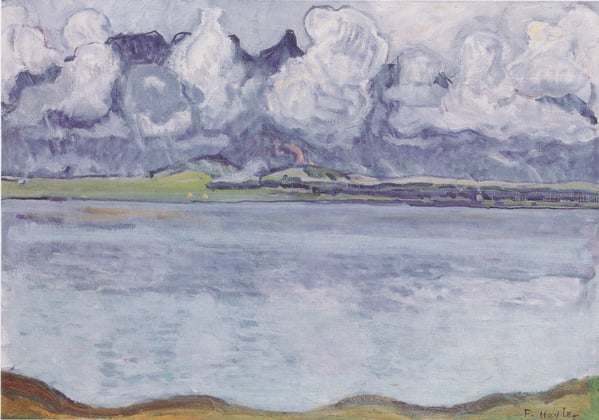
Ferdinand Hodler’s Thun, Stockhornkette, in clouds stands as a quintessential example of how Art Nouveau’s decorative language could be fused with a deeply personal, almost spiritual vision of landscape. Created during his mature period, the work embodies Hodler’s signature principle of “Parallelism”—a rhythmic, symmetrical ordering of forms that elevates a natural vista into a universal, symbolic statement.
Significance within the Art Nouveau (Modern) Style
Hodler was a bridge between the decorative surface patterns of Art Nouveau and the symbolic, psychological currents of Symbolism. In this painting, the landscape is not merely a topographical record of the Stockhorn chain near Lake Thun; it is a structured meditation on the sublime. Key Art Nouveau characteristics appear in:
- Rhythmic Line and Repetition: The clouds are not rendered as soft, formless masses but as a series of parallel, almost calligraphic curves that echo the mountain ridges below. This repetition creates a unifying, decorative rhythm across the canvas, typical of Art Nouveau’s love for flowing, organic linework.
- Flatness and Decorative Surface: Hodler flattens spatial depth, compressing the distance between the foreground lake, the hills, and the clouds into a two-dimensional pattern. The horizon is high, and the sky becomes a tapestry of stacked, undulating cloud-bands. This approach prioritizes the aesthetic harmony of the picture plane over naturalistic recession—a hallmark of the Modernist shift away from Renaissance perspective.
- Nature as Organic Structure: The composition feels both structured and alive. The clouds mimic the horizontal stratification of the distant mountains, suggesting a cosmic unity. The painting’s symmetry implies a hidden order in nature, aligning with Art Nouveau’s desire to find a universal, organic design principle beneath visible reality.
What Makes the Work Significant
-
Hodler’s “Parallelism” in Action: More than any other Swiss painter, Hodler developed a theory where parallel lines, repeated shapes, and symmetrical arrangements express eternal truths. Thun, Stockhornkette, in clouds is a textbook example: the parallel drift of clouds, the horizontal bands of mountain terrain, and the even reflection on the lake create a meditative, mantra-like visual pulse. This rhythmic order elevates a specific Swiss alpine view to a timeless icon of nature’s grandeur.
-
Synthesis of Landscape and Symbolism: While the subject is clearly recognisable as the Stockhorn range, Hodler transforms it into a symbol of transcendence. The clouds act as a veil between the earthly and the infinite. This aligns with the period’s interest in using landscape as a vehicle for emotional and spiritual experience—a tendency seen in the work of contemporaries like Edvard Munch (in his landscapes) and the early symbolist work of Gustav Klimt.
-
National Identity and Modernity: The painting reflects a specifically Swiss interpretation of Art Nouveau—one grounded in the stark, monumental beauty of the Alps. Rather than the Parisian elegance of Mucha or the Viennese eroticism of Klimt, Hodler’s modernism is austere, clean, and quasi-religious. Thun, Stockhornkette, in clouds thus represents a crucial moment when a national landscape tradition was modernised through a decorative, symbolic lens.
In summary, this work is significant for demonstrating how Hodler’s stringent compositional system—rooted in repetition and symmetry—transformed a straightforward Alpine landscape into an icon of Art Nouveau’s abstract, spiritualized view of nature. It stands as a masterful blend of observation and idealization, local identity and international style.
視覚的に類似
構図やパレットが近い作品 20 件
Thun, Stockhornkette
Ferdinand Hodler
Rising mist over the Savoy Alps
Ferdinand Hodler
Mountain Home, Idaho
Childe Hassam
Landscape with of rhythm
Ferdinand Hodler
A Western Lough
Paul Henry
Lake Geneva with Mont Blanc in the morning light
Ferdinand Hodler
Italian Lakeside Landscape
Fujishima Takeji
Thunersee mit Niesen
Cuno Amiet
Lake Geneva with Mont Blanc at dawn
Ferdinand Hodler
Lake Geneva, overlooking the Savoyerberge
Ferdinand Hodler
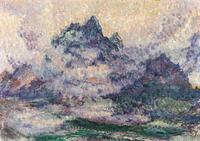
View To The Mount Santis
Willy Schlobach
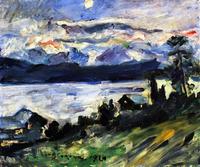
The Walchensee on Saint John's Eve
Lovis Corinth
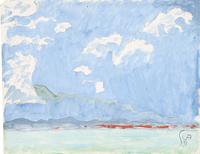
Thunersee
Cuno Amiet
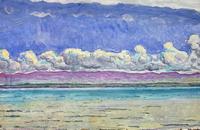
The Lake
Ferdinand Hodler
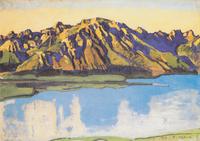
The Grammont in the morning sun
Ferdinand Hodler
Dodge Ranch
Xavier Martinez
Vu D'un Lac
Willy Schlobach
The Walchensee with Mountain Range and Shore
Lovis Corinth
Lake Geneva with Mont Blanc at dawn
Ferdinand Hodler
Seascape Near Trouville
Gustave Courbet