Expert Analysis: "View of the Horn of Fromberg from Reichenbach" by Ferdinand Hodler
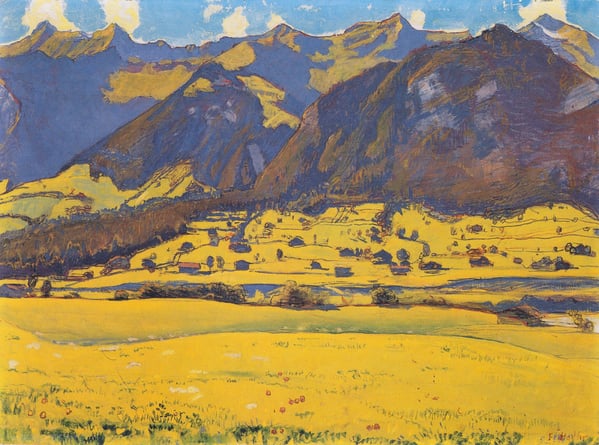
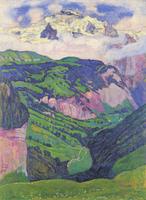
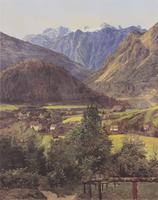
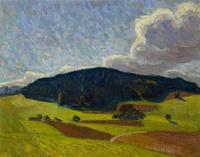
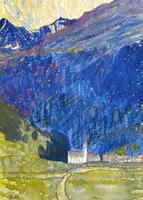
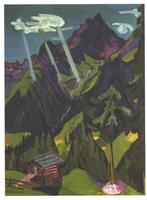
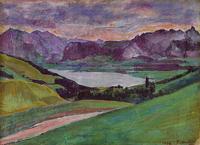
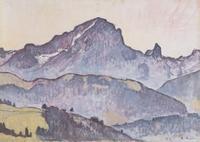
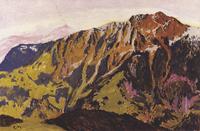
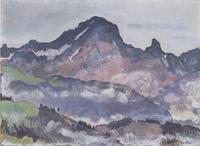
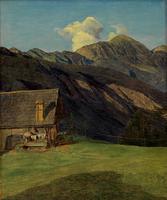
As a landscape executed within the Art Nouveau (Modern) style, this work by Ferdinand Hodler achieves significance through its radical synthesis of natural observation with the decorative, symbolic impulses of the movement. Rather than merely recording a topographical scene, Hodler transforms the Alpine vista of the Horn of Fromberg into a rhythmic, almost musical composition.
The painting’s importance lies in its embodiment of Hodler’s signature theory of parallelism. This is evident in the repeated, sweeping horizontal lines of the mountain ridges, clouds, and foreground terrain — a hallmark of Art Nouveau’s emphasis on organic, flowing contours. By flattening the depth and aligning natural forms into parallel bands, Hodler creates a decorative unity that transcends mere representation. The landscape becomes a symbolic reflection of cosmic order and emotional intensity, a key modernist departure from earlier naturalism.
Within the context of Art Nouveau, Hodler’s work stands out because it leverages the style’s decorative linearity not for ornamental excess but for metaphysical resonance. The sharp, stylized outlines of the peaks and the muted, symbolic color palette evoke a sense of the sublime — the Swiss Alps rendered not as picturesque backdrop but as a living, rhythmic force. This painting is significant because it marries the Art Nouveau passion for integrated, harmonious design with the modern artist’s search for universal truths in nature, establishing Hodler as a pivotal figure who pushed landscape painting toward abstraction and emotional symbolism.