Expertenanalyse zu Ferdinand Hodlers The Lady of the Isenfluh
Stil: Art Nouveau (Modern) · Genre: landscape
Expert Analysis of "The Lady of the Isenfluh" by Ferdinand Hodler
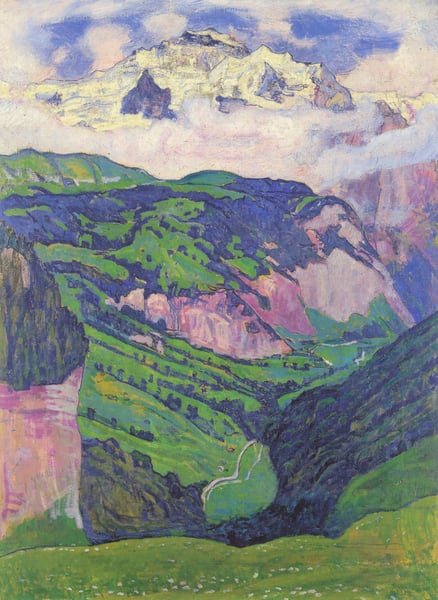
Ferdinand Hodler’s The Lady of the Isenfluh stands as a compelling synthesis of landscape and figurative symbolism within the Art Nouveau (Modern) idiom. Although the title suggests a female subject, the work is classified as a landscape, indicating that the figure—likely a woman—is integrated into the natural setting as an emblematic presence rather than a narrative protagonist. This merging of human form with topography is a hallmark of Hodler’s mature style and elevates the painting beyond mere topography.
Significance within Art Nouveau and Modern Landscape
-
Rhythmic Parallelism and Decorative Wholeness
True to Art Nouveau’s love for flowing, organic lines, Hodler employs his signature parallelism—repeating curves in the mountain slopes, tree silhouettes, and the figure’s posture. This creates a unified, almost musical rhythm that binds the figure to the landscape. The lady’s form likely echoes the contours of the Isenfluh cliffs, dissolving the boundary between human and nature. Such treatment transforms a Swiss Alpine view into a symbolic meditation on unity—a core Art Nouveau ideal. -
Symbolic Transcendence
Genre: landscape here is not merely descriptive. Hodler infuses the scene with spiritual gravity. The “lady” may represent a guardian spirit of the mountain or an allegory of solitude and eternity. The flat, decorative planes of color—rich greens, blues, and earth tones—reduce naturalistic detail in favor of emotional resonance. This aligns with Modernist landscape painting’s shift from imitation to expression, and with Art Nouveau’s preference for stylized, symbolic forms. -
Swiss National Identity
Hodler was a leading figure in Swiss modernism. The Lady of the Isenfluh reflects his lifelong fascination with the Alps as sites of both physical grandeur and metaphysical force. By personifying the landscape, he creates a distinctly Swiss emblem—one that feels both timeless and avant-garde. The work thus occupies a pivotal place between nineteenth-century Romantic landscape and the symbolic abstraction of early modern art.
Conclusion
The Lady of the Isenfluh is significant for its seamless fusion of figure and terrain, its rhythmic, decorative composition, and its elevation of landscape into a vessel for spiritual meaning. It exemplifies how Art Nouveau principles—line, symbolism, and organic unity—could be applied to the natural world, reaffirming Hodler’s role as a master of modern symbolic landscape.
Visuell ähnlich
20 Werke mit ähnlicher Komposition und Farbpalette
View of the Horn of Fromberg from Reichenbach
Ferdinand Hodler
Semmering Landscape
Koloman Moser
Imereti
David Kakabadze
Lake Thun
Ferdinand Hodler
Twin Peaks, Rockies
Albert Bierstadt
Grand Muveran
Ferdinand Hodler
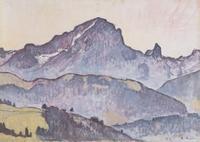
From Le Grand Muveran Villars
Ferdinand Hodler
The Valley of Saint-Vincent
Theodore Rousseau
Landscape in Graubünder with Sun Rays
Ernst Ludwig Kirchner
Caves Prunal near Pontgibaud (Auvergne)
Armand Guillaumin
In the mountains. Switzerland
Zinaida Serebriakova
Høifjeld
Knud Baade
Høifjeld
Knud Baade
The Gastein Valley I
Anton Romako
The Rax
Koloman Moser
Overlooking the Valley of the Gouffre, Charlevoix
Clarence Gagnon
Mountain Landscape
Albert Bierstadt
Landscape with small town
Cesare Tallone
The Grand Muveran
Ferdinand Hodler
Schynige plate
Ferdinand Hodler