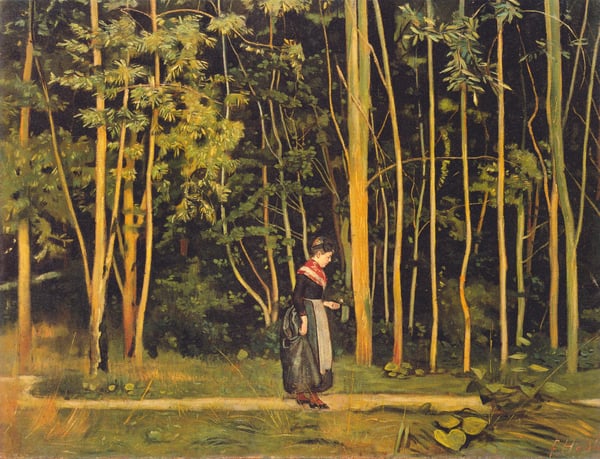
Expert analysis of Ferdinand Hodler’s Walking at the forest edge
Style: Art Nouveau (Modern) · Genre: genre painting
Expert Analysis: "Walking at the forest edge" by Ferdinand Hodler
Style & Period Context (Art Nouveau / Modern)
Ferdinand Hodler’s Walking at the forest edge is a quintessential example of Art Nouveau’s synthesis of natural forms and symbolic human experience, while also signaling the transition toward modernist abstraction. In this work, Hodler applies his signature principle of Parallelism—the rhythmic repetition of lines, shapes, and motifs—to create a unified, almost musical composition. The forest edge serves as a liminal space where the organic curves of trees and foliage echo the upright figures, embodying Art Nouveau’s fascination with nature’s underlying structures. The flattened perspective and stylized contours reflect the movement’s decorative elegance, yet Hodler’s treatment of the scene elevates it beyond mere ornamentation, infusing it with a meditative, universal quality.
Genre Painting Significance
As a genre painting depicting an everyday activity (walking at the forest’s boundary), the work transforms a mundane moment into a profound statement on humanity’s relationship with nature. Hodler’s figures—often solitary or paired—are not merely anecdotal but become archetypes of contemplation or journey, aligned with the modern impulse to find symbolism in the ordinary. This fusion of genre subject matter with monumental, rhythmic composition was groundbreaking within the Art Nouveau movement, which typically reserved such formal rigor for decorative arts or allegorical subjects. By applying the same principles to a simple walk, Hodler anticipated the modern emphasis on subjective experience and the rhythmic flow of life.
What Makes It Significant
The painting’s significance lies in its tight integration of harmonic repetition (the parallel verticals of trees and walkers) with the psychological tension of the forest edge—a threshold between civilization and wilderness, order and mystery. Hodler’s use of color (often modulated, subdued earth tones) and simplified silhouettes prefigures early modern abstraction, while his commitment to Parallelism became a hallmark of his mature style, influencing later Symbolist and Expressionist artists. In the context of Art Nouveau, Walking at the forest edge stands out as a masterful blend of decorative pattern and existential depth, demonstrating that genre painting could carry the same philosophical weight as large-scale historical or mythological works.
Visually similar
20 works with related composition and palette
A Summer Morning Tiff
Tom Roberts
In the Forest
Konstantin Somov
Lady in the forest
Giovanni Fattori
Figures in a Forest
Camille Corot
Landscape with a Woman
Ivan Shishkin
Little Gossips
Jane Sutherland
Worried Waiting
Clovis Trouille
The Letter
Frederick McCubbin
Birch Grove
Ivan Shishkin
A Walk in the Woods (Madame Lecoeur and Her Children)
Pierre-Auguste Renoir
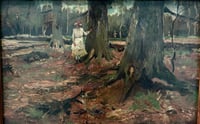
Meisje in het bos
Vincent van Gogh
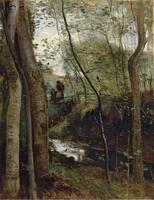
Stream in the Woods
Camille Corot
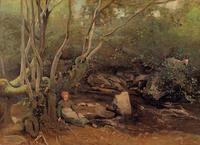
Lormes Shepherdess Sitting under Trees beside a Stream
Camille Corot
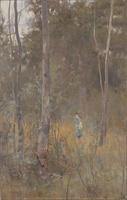
Lost
Frederick McCubbin
Les Alinges, Haute Savoie, Figures under the Trees
Camille Corot
Forest
Ivan Shishkin
Forest road
Ivan Shishkin
A Walk in the Forest
Ivan Shishkin
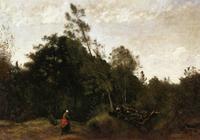
Forest Clearing in the Limousin
Camille Corot
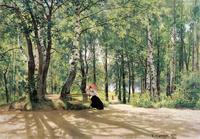
At the Summer Cottage
Ivan Shishkin