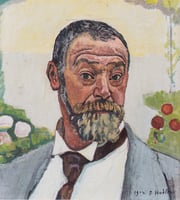
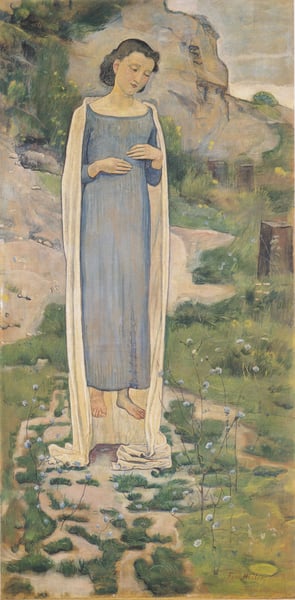
Expertenanalyse zu Ferdinand Hodlers What the Flowers Say
Stil: Art Nouveau (Modern), Symbolism · Genre: symbolic painting
Expert Analysis: "What the Flowers Say" by Ferdinand Hodler
Ferdinand Hodler’s “What the Flowers Say” is a quintessential work that bridges the decorative elegance of Art Nouveau with the introspective depth of Symbolism. As a symbolic painting, it transcends mere representation, using floral motifs as a vehicle for philosophical inquiry—a hallmark of Hodler’s mature style.
Significance within Symbolism and Art Nouveau:
- Nature as a Spiritual Language: The title itself frames flowers as communicators of hidden truths. Hodler—deeply influenced by his pantheistic leanings—often portrayed nature not as a backdrop but as an active, living force. Here, the flowers likely embody ideas of transience, renewal, or the cyclical rhythms of life, reflecting the Symbolist quest for meaning beyond the visible world.
- Rhythmic Composition: Hodler’s signature device—Parallelism (the repetition of forms, colors, and gestures)—animates the scene. In “What the Flowers Say,” stems, petals, and human figures (if present) are organized into sweeping, symmetrical rhythms that suggest a harmonious dialogue between humanity and nature. This structured yet organic flow is central to Art Nouveau’s love of sinuous lines, yet Hodler infuses it with a meditative solemnity rarely seen in the movement’s more ornamental works.
- Psychological Resonance: Unlike many Art Nouveau artists who focused on stylized surface beauty, Hodler combines decorative patterning with a profound psychological charge. The flowers are not mere decoration—they can be interpreted as symbols of the sublime, echoing the artist’s fascination with the indivisible unity of existence. The work anticipates his later, monumental symbolic paintings, such as “The Day” and “Truth,” where natural elements become metaphysical messengers.
Art-Historical Impact:
“What the Flowers Say” is significant for demonstrating how Symbolism could absorb Art Nouveau’s visual language without losing its intellectual rigor. It stands as a precursor to the modern abstraction of nature—a bridge between the 19th-century romanticization of flora and the 20th-century exploration of inner emotional landscapes. Hodler’s ability to make flowers “speak” through pure visual rhythm and symbolic ambiguity secures this work’s place as a masterful fusion of two defining fin-de-siècle movements.
Museum / Gallery
Visuell ähnlich
20 Werke mit ähnlicher Komposition und Farbpalette
The Consecrated One
Ferdinand Hodler
The Fairy Princess
John Bauer
The Turn of the Tide
John Duncan
The Annunciation
Arthur Hughes
Illustration for Vyšehrad
Artuš Scheiner
Dante and Beatrice
John William Waterhouse
Silence of the Evening
Ferdinand Hodler
Merlin and the Fairy Queen
John Duncan
The Emergence of Clemence Isaure with Troubadours
Henri Martin
Mognonne Allons Voir si la Rose
Paul Serusier
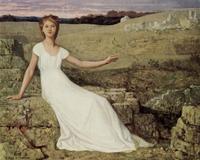
Hope
Pierre Puvis de Chavannes
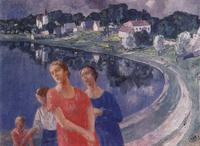
In Shuvalovo
Kuzma Petrov-Vodkin
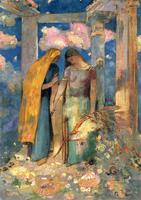
Mystical Conversation
Odilon Redon
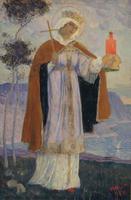
Holy Equal-to-the-Apostles Olga
Mikhail Nesterov
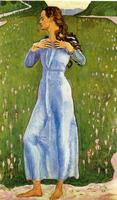
Emotion
Ferdinand Hodler
Washerwomen at the Laita River, near Pouldu
Paul Serusier
The Rose Robe
Henri Martin
The Annunciation
Arthur Hacker
Saint Barbara
Mikhail Nesterov
Return of the Holy Women
Henry Ossawa Tanner