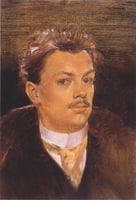
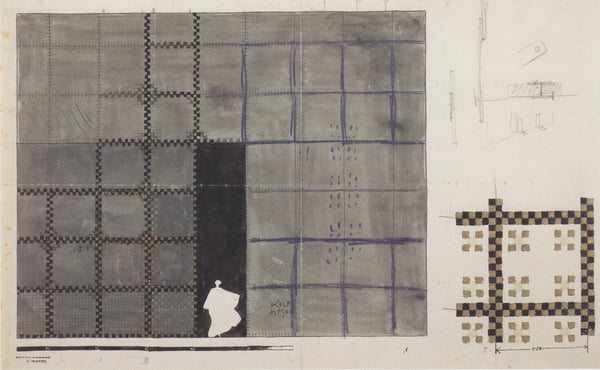
Koloman Moser の Design for a Stage Decoration の専門的な分析
スタイル:Art Nouveau (Modern) · ジャンル:design
Analysis of "Design for a Stage Decoration" by Koloman Moser
Koloman Moser’s Design for a Stage Decoration exemplifies the Art Nouveau (Modern) movement’s ambition to dissolve boundaries between fine art, applied art, and everyday life. As a founding member of the Vienna Secession and a key figure in the Wiener Werkstätte, Moser championed a total work of art (Gesamtkunstwerk), where every element—including stage design—was integrated into a harmonious, stylized whole.
Significance within Art Nouveau (Modern):
- Synthesis of forms: Moser’s stage designs typically merge organic, flowing lines (a hallmark of Art Nouveau) with geometric rigor, reflecting the Secessionist preference for abstraction and order over naturalistic imitation. This piece would have used sinuous curves, flat decorative patterns, and rhythmic repetition to create a visually cohesive environment that transcends mere backdrop.
- Functional aesthetic: The designation “design” underscores its practical purpose, yet Moser elevates it to fine art. Stage decoration in this period was not just scenery but a spatial expression of modernism—flattening perspective, emphasizing two-dimensional pattern, and challenging traditional illusionistic theater.
- Modernist innovation: Moser’s work influenced stagecraft by prioritizing mood and symbolic color over literal representation, anticipating later Expressionist and Bauhaus stage designs. His collaboration with the Vienna Secession ensured that even commercial or decorative projects carried avant-garde credibility.
Contextual importance:
- As a designer for the Secession’s exhibitions and the Wiener Werkstätte, Moser’s stage decoration would have embodied the movement’s rebellion against historicism, favoring clean lines, restrained ornament, and a modernized vocabulary of nature-derived motifs (e.g., stylized leaves, whiplash curves).
- In the broader Art Nouveau canon, Moser stands out for his ability to merge the ethereal elegance of the style with the functional demands of performance space, making this work a precise artifact of the Modern era’s redefinition of art’s role in public and private life.
While specific visual details are not provided, the work’s significance lies in its demonstration of Moser’s core principle: that art must infiltrate every aspect of human experience, from the intimate to the theatrical. Design for a Stage Decoration is thus not merely a drawing, but a manifesto for the Secessionist ideal of a total, modern environment.
視覚的に類似
構図やパレットが近い作品 20 件
Composition (Study)
Theo van Doesburg
Water
Oleksandr Aksinin
Color design for the ceiling of the Cafe Brasserie
Theo van Doesburg
Union Grey
Sean Scully
Sketch for a poster of the Vienna Workshop
Koloman Moser
Stained glass composition
Theo van Doesburg
Pliage (Folded Painting)
Andre-Pierre Arnal
Criminals and their Properties
Alvaro Lapa
Toile tamponnée
Louis Cane
Preliminary design for the floor
Theo van Doesburg
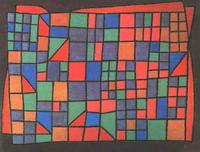
Glass Facade
Paul Klee
Sketch of Four Compositions
Hryhorii Havrylenko
Games Mysteries
Oleksandr Aksinin
Untitled
Gunther Forg
Untitled (from Tiles)
Brice Marden
Geometric Collage
Jean Arp
Structural II
Paul Klee
Fire
Oleksandr Aksinin
Sculptural Composition 'Three Russian Revolutions. 1825, 1905 and 1917'. Sketch
Vasyl Yermylov
Toile tamponnée
Louis Cane